
Peel Adhesion Test Conditions: Why One Roll Reads 6 N/25 mm in Guangzhou and 14 N/25 mm in Rotterdam
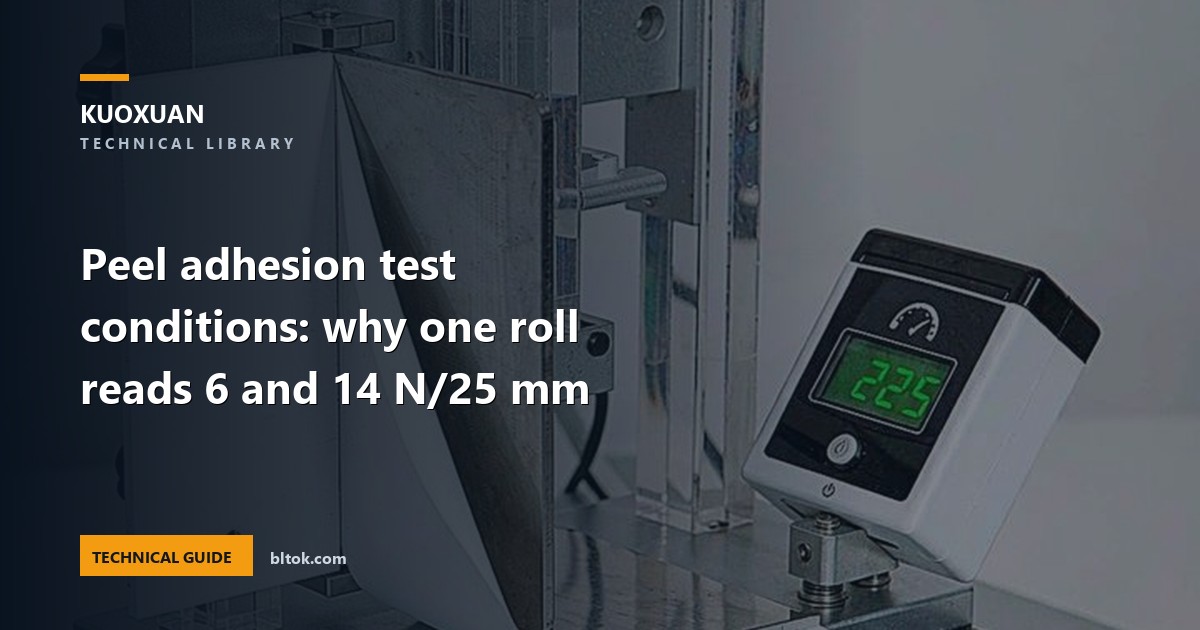
A peel adhesion figure quoted without its test conditions is not a specification — it is a rumour. The same production lot of permanent acrylic labelstock can read 6 N/25 mm in one laboratory and 14 N/25 mm in another, and both laboratories can be right. Four things move that number more than the adhesive formulation does: the panel the strip was peeled from, how long it dwelt there, the speed and angle of the peel, and the width the force was divided by. When a converter in Guangzhou and a brand owner in Rotterdam disagree about whether a roll is in spec, the argument is almost never about polymer chemistry. It is about two documents that each state a number and neither states the conditions behind it.
This article is for the person who has to settle that argument: the engineer approving a data sheet, the buyer comparing quotations, the quality manager holding a failure report from a customer's test house.
What a peel number measures, and the four things it leaves out
Pressure-sensitive adhesion is a viscoelastic event, not a fixed bond strength. The adhesive is a very high-viscosity liquid that has to flow into microscopic contact with a surface, and the force needed to pull it back off depends on how much contact it managed to make and how fast you are asking it to let go. A peel test therefore measures a rate-dependent, time-dependent, surface-dependent response — and reports it as a single scalar in newtons per unit width.
That scalar is a test result, not a material property. It belongs to the specimen, the panel and the protocol that produced it. Four conditions dominate:
- Peel angle. At 180° the facestock is folded back on itself, so the backing's own bending stiffness enters the measurement; at 90° it does not, and a 90° fixture usually reports higher for the same material. The two results are not interchangeable, and a supplier quoting one to a buyer expecting the other can appear to have doubled the adhesion without changing anything.
- Peel speed. Faster peeling raises the measured force, because the adhesive has less time to relax. Standard methods fix this at 300 mm/min for exactly that reason, and a laboratory running at 500 mm/min is measuring a different product.
- Dwell time. The interval between rolling the strip down and pulling it off. This is the single largest source of disagreement in practice, and it gets its own section below.
- Reporting width. Force per 10 mm, per 25 mm, or per inch. The adhesion is identical; the number changes by a factor of 2.5 or 25.4 depending on which you divide by.
A fifth variable rarely reaches the data sheet: failure mode. Clean release, cohesive tearing and transfer off the facestock can all produce similar peak forces, and only the mode tells you which layer to change.
Five ways to report the same adhesive
The standards most often cited in labelstock trade are ASTM D3330, PSTC-101, FINAT FTM 1, ISO 29862 and, in China, GB/T 2792. They are not five different tests so much as five different sets of house rules applied to the same 180° geometry, and the differences are large enough to explain most cross-border disputes on their own.
| Method | Standard panel | Default dwell | Peel speed | Reported as | Practical consequence |
|---|---|---|---|---|---|
| ASTM D3330, Method A | Polished 302/304 stainless steel, solvent-cleaned before each specimen | About 1 minute; longer dwell only if the buyer specifies it | 300 mm/min | N/100 mm, N/25 mm or oz/in | The default in North American data sheets. The 1-minute dwell captures early grab, not final adhesion. |
| PSTC-101 | Stainless steel | Typically 1 minute, or 20 minutes when called out | 300 mm/min | N/10 mm or oz/in | Numerically the smallest of the group for the same adhesive, purely because of the 10 mm divisor. |
| FINAT FTM 1 | Float glass | Reported at both 20 minutes and 24 hours | 300 mm/min | N/25 mm | The European label industry default. The 24-hour figure is usually well above the 20-minute figure, and both get printed. |
| ISO 29862 | Stainless steel or glass, stated per method | Method-dependent, stated | 300 mm/min | N/25 mm | Four 180° methods harmonised with PSTC, AFERA and FINAT — the closest thing to a common language between the other four. |
| GB/T 2792 | Stainless steel | Typically 20 minutes | 300 mm/min | N/25 mm | A modified adoption of an earlier edition of ISO 29862, so it sits close to the FINAT dwell convention but on the ASTM panel. |
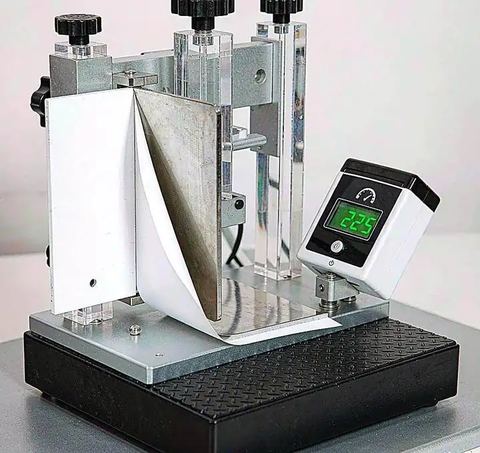
Read that table as a conversion problem, not a quality ranking. An adhesive reading 15 N/25 mm under FINAT FTM 1 at 24 hours will commonly read near 6 N/10 mm under PSTC-101 at 1 minute, and neither number is wrong: multiply by 2.5 and the units reconcile, leaving the dwell difference as the only remaining gap. A buyer comparing a European data sheet against an Asian one without normalising both is comparing a 24-hour adhesion to a one-minute adhesion and calling the result "quality". Carry two conversions in your head — one newton per 25 mm is roughly 102 grams per 25 mm, and a 24 mm strip peeling at 6.0 N reports as 25 N/100 mm and 6.25 N/25 mm, one measurement at two magnitudes.
The panel problem: stainless steel is not your bottle
Every standard in that table uses polished stainless steel or float glass, so the adhesive wets out fully and the test measures the adhesive rather than the substrate. That is also why standard peel figures are optimistic — they describe the best case the adhesive will ever see.
Surface energy decides whether the adhesive can wet a surface at all. The working threshold in pressure-sensitive labelling sits at roughly 36–38 dyn/cm: above it a standard permanent acrylic flows into contact and bonds predictably, below it the adhesive beads instead of wetting, so the label holds on application and lifts days later. Untreated polypropylene sits near 29 dyn/cm and polyethylene near 31 dyn/cm — both below the line, and both extremely common container materials: shampoo bottles, jerrycans, detergent flasks, thermoformed trays.
The practical effect on a peel reading is severe and asymmetric. On stainless steel a general-purpose permanent acrylic typically lands in the 10–20 N/25 mm band at short dwell, and a removable grade in the 2–8 N/25 mm band. On an untreated HDPE bottle wall the same permanent grade may not reach the bottom of the removable band, because the failure has moved from the adhesive-panel interface to a partial wetting failure that never developed full contact area. A supplier testing only on steel will never see this; a buyer testing only on the bottle will conclude the material is bad.
The fix is procedural before it is chemical. Buy dyne test inks and measure the actual container, on the production surface, after any flame or corona treatment and after that treatment has had time to decay — treated polymer surfaces lose energy over weeks as additives migrate outward. Below roughly 36 dyn/cm, no increase in adhesive coat weight will rescue the bond; you need a low-surface-energy adhesive system, and the specification should say so rather than hoping a "high tack" grade covers it.
| Construction | Adhesive chemistry | Typical 180° peel on steel, short dwell | Behaviour on low-energy plastic | Where it belongs |
|---|---|---|---|---|
| White BOPP face, standard permanent | Water-based acrylic | Roughly 10–20 N/25 mm | Poor below 36 dyn/cm; beads and lifts | PET, glass, metal, coated board, rigid HDPE with treatment |
| White BOPP face, LSE-modified permanent | Modified acrylic, tackified | Roughly 8–16 N/25 mm | Designed to wet out below 36 dyn/cm; the correct answer for PP and PE | Untreated PP/PE containers, powder-coated metal, soft-touch laminates |
| Paper face, high-tack hot melt | Hot-melt rubber | Roughly 12–20 N/25 mm, falling with heat and UV | Good initial grab, degrades under UV and solvent | Corrugated cases, dry irregular surfaces, short-life logistics labels |
| White PET face, solvent acrylic | Solvent acrylic | Roughly 8–15 N/25 mm | Moderate; needs a primed or treated surface | Chemical exposure, high heat, durable goods, outdoor service |
The ranges in that table are industry-typical bands, not a promise about a specific batch. They show the shape of the problem: the spread between constructions on steel is modest, the spread between steel and a real bottle is not.
A peel figure also stops being a lab curiosity once it meets tooling. If the label is kiss-cut on a rotary die, the die-setting window depends on liner calliper and release force as much as on adhesive, which the glassine liner guide covers; if the print platform is UV inkjet, ink anchorage on the face is a separate variable handled in the receptive coating guide. Peel adhesion is one number in a specification that has at least a dozen.
Dwell time: the number that keeps growing after you sign
Pressure-sensitive adhesive keeps building bond after application. The strip that reads 9 N/25 mm one minute after roll-down can read 12 at twenty minutes, 15 at twenty-four hours, and materially more again after a month on the shelf. Published bonding guidance commonly describes a two-to-three-fold rise between an initial reading and a reading taken after 30–60 days, depending on the adhesive family and the substrate.
This is why FINAT reporting both a 20-minute and a 24-hour figure is more honest than a single number, and why an ASTM Method A figure taken at one minute measures initial grab rather than final adhesion. It is also why a complaint arriving three weeks after application can puzzle a supplier who qualified in a one-minute test: the adhesive has kept building, the label is now harder to remove than specified, and if the product is a removable grade, the "removable" claim has quietly expired.
Temperature accelerates the same process. An adhesive reaching final bond in thirty days at 23 °C may reach most of it in a week at 40 °C, so a pallet in a hot warehouse ages faster than the qualification schedule assumed. The standard laboratory condition of 23 ± 1 °C and 50 ± 5 % RH is not a formality — it is the reference point that makes two readings comparable, and specimens are normally conditioned there for 24 hours.
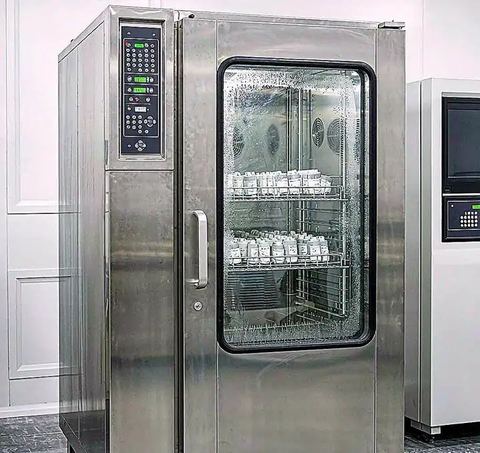
Dwell is also where purchase orders go wrong. "Peel adhesion min. 10 N/25 mm" says nothing about when to measure; "180° peel from stainless steel per ASTM D3330 Method A, 24 mm width, 20-minute dwell, 300 mm/min, mean of three specimens with failure mode" can be checked.
Shear, tack, and the standards that no longer exist
Peel, tack and shear are three different questions and none substitutes for the others. Peel asks how much force removes the label. Tack asks how fast it grabs on light contact. Shear asks how long it holds under a constant load applied parallel to the bond — a time to failure, not a force — and it is the number that governs whether a label creeps down a vertical bottle in a warm warehouse. A high peel figure says nothing useful about creep.

Two standard numbers still circulating in data sheets have been withdrawn, which makes them a useful dating signal. The probe tack method ASTM D2979 was withdrawn in 2019 with no direct replacement, and the shear adhesion failure temperature method ASTM D4498 in 2021. A document citing either as current was probably compiled from an older template and never revisited — the numbers are not necessarily false, but it does tell you how much attention the document received. Ask what was used instead, and expect a specific answer: a stated load, ramp rate and geometry, or a loop tack figure per ASTM D6195 or FINAT FTM 9.
From a 1,080 mm web to a purchase clause
A peel figure is only as good as the batch it came from, and a batch is a coating run. Our line coats a web up to 1,080 mm wide at 180 m/min, which means adhesive coat weight has to be held uniform across the full width while the web moves at three metres a second. Coat weight drives peel directly: a heavier coat reads higher and builds to final bond more slowly, a lighter coat the reverse. Transverse drift across a 1,080 mm web becomes a peel gradient from one edge of the roll to the other, and a converter slitting that roll into narrow widths gets labels that behave differently depending on which lane they came from.
That is why our batch release rests on five checks rather than one, and why peel is only one of them. Initial tack, holding power, 180° peel, climate ageing and coating appearance are recorded for each batch, and the peel figure is read alongside the other four. A batch that passes peel and fails climate ageing lifts in a container six weeks later; a batch that passes both and carries a coating defect fails at the die. The five together describe the batch; any one alone describes a specimen.
What this means for a buyer is that the number worth asking for is the batch figure with its conditions attached, not the catalogue figure — and asking for it is reasonable, not an imposition. It is also the fastest way to find out whether a supplier tests at all. One who can produce a batch peel reading with panel, dwell, speed and failure mode stated is measuring; one who can only produce a number copied from a brochure is not.
Then comes the arithmetic of qualifying a material, where good specifications usually die. Our minimum order is 1,000 m² and production runs 15–25 days for stock constructions. At 100 × 150 mm, 1,000 m² is roughly 66,000 labels before gap allowance — enough to qualify on two applicators, age a sample for a month and still have stock for live despatch. It is not enough to carry a national roll-out, so the second order belongs while the first is still under test, not after it has passed. Lead time plus ocean transit decides whether you are qualifying material or rationing it.
Six clauses close most of the gap between a peel figure and a peel agreement:
- Name the method and its variables. "ASTM D3330 Method A" leaves the dwell open; add panel, width, dwell and speed.
- State your real substrate. On untreated HDPE a steel-panel figure is a ceiling, not a prediction. Require a reading on the production container, or a dyne reading with a threshold.
- Ask for the failure mode. Adhesive failure, cohesive failure and transfer point to three different layers.
- Fix the dwell you will measure at. Incoming inspection at one minute and a certificate at 24 hours will never reconcile.
- Do not mix 90° and 180°. If your line uses a 90° fixture, ask for the 90° figure rather than converting.
- Ask for the batch, not the grade. A grade's typical value is a marketing document; a batch value with conditions is evidence.
The wider picture — which of the six layers owns which failure — is in the layer-by-layer article, and substrate-to-adhesive matching in the twelve-substrate selection matrix. The methods described here are the ones we run in production; the coating and inspection process page describes the line they run on, and the technical library holds the data sheets that carry the readings.
None of this makes peel adhesion difficult to specify. It makes it a number that has to be specified rather than assumed. The material is rarely the problem; the document is.
FAQ
Why does my own peel test give a lower figure than the supplier data sheet?
Because the two tests almost certainly used different conditions. A data sheet figure is normally taken on polished stainless steel with a short dwell, which is the most favourable surface an adhesive will ever meet. Your incoming inspection is probably peeling from your actual container, at a longer dwell, possibly at a different width. Before treating the gap as a quality problem, put both numbers side by side with the panel, dwell, speed and reporting width stated. In most cases the figures reconcile once the units are normalised, and the remaining difference is the substrate rather than the adhesive.
Should a labelstock purchase order cite ASTM D3330, PSTC-101 or FINAT FTM 1?
Cite the one your own incoming inspection can actually run, and state the dwell explicitly whichever you choose. ASTM D3330 Method A is the most common reference in North American and Asian supply chains and uses stainless steel with a short default dwell. PSTC-101 reports in N/10 mm, which produces numerically smaller figures for the same adhesive. FINAT FTM 1 is the European label industry standard and reports at both 20 minutes and 24 hours on float glass. A clause that names a standard but leaves the dwell open still leaves room for a dispute, because the dwell changes the result more than the standard does.
Can I convert a PSTC-101 result in N/10 mm into N/25 mm?
Yes, and the conversion is exact because width is a linear divisor. Multiply the N/10 mm figure by 2.5 to express it as N/25 mm, or divide by 2.5 to go the other way. What cannot be converted is a dwell difference: a one-minute reading cannot be scaled to a 24-hour reading with any coefficient, because adhesion builds at a rate that depends on the adhesive family, the substrate and the temperature. Convert units freely, then re-test rather than extrapolate whenever the dwell differs.
How long should a label dwell before the peel is measured?
There is no single correct answer, which is exactly why the dwell has to be written into the specification. Standard methods default to about one minute, which captures initial grab. European practice reports at 20 minutes and again at 24 hours, which captures the build towards final adhesion. Published bonding guidance describes a two-to-three-fold rise between an initial reading and one taken after 30 to 60 days, so a removable grade specified at a short dwell may no longer be removable after a month on the shelf. Pick the dwell that matches your customer experience and use it on both sides of the transaction.
Is peel adhesion enough to qualify a labelstock, or do I need shear and tack as well?
Peel alone is not enough, because it answers only one of three questions. Peel measures the force to remove a label, tack measures how quickly it grabs on light contact, and shear measures how long it holds under a constant parallel load. A label on a vertical bottle in a warm warehouse fails by creep, which is a shear failure that a high peel figure will not predict. Ask for all three, and ask for the failure mode on the peel test as well, since that tells you whether the weak point is the adhesive-panel interface, the adhesive itself, or the bond between adhesive and facestock.