
Poly-coated kraft is the liner buyers reach for when labels have to survive a wet season, six weeks of sea freight and an unconditioned warehouse. The polyethylene layer is doing one job — sealing the paper so it stops absorbing water — and almost every specification mistake on these liners comes from not saying which paper, how much PE, and on which side.
Model guide · last verified 2026-10-21 · published in English · technical questions: contact the lab
The polyethylene is not there for strength. It is there to close the sheet: extruded onto the paper, it seals the fibres off from the air, so the liner can no longer take up moisture from a humid warehouse. Everything that follows from a poly-coated liner follows from that one change.
A sealed liner cannot swell, so its caliper stays stable, so it does not curl, so print-to-die registration stays where you set it. An unsealed glassine liner does absorb water, mostly through the exposed back face, and the construction curls towards the drier side — which is why the same material behaves perfectly in a European winter and badly in a Brazilian summer.
The costs are equally mechanical. Extrusion adds caliper and stiffness, so there are fewer metres per roll, the die-cut depth window narrows, and the web behaves differently through tight turn bars. It is also opaque, so it cannot be used where a clear liner is part of the finished look.

Poly-coating is a process, not a single product. The base paper decides the stiffness and the printability; the polyethylene decides only the barrier. Four base papers cover almost every enquiry we get.
Kraft, 60–90 gsm. The default. Cheap, strong, and the natural choice for a liner that will be seen by nobody but the press operator.
Coated art paper, 80–100 gsm. Used when the liner back has to be printable — a converter who prints a brand or a handling instruction on the reverse of the release paper. A poly layer gives the ink a sealed, consistent surface.
Woodfree / uncoated paper. Where absorbency on the face side is wanted while the back stays sealed, for example on certain sheeted products.
Glassine. Normally supplied uncoated because its whole value is being thin and dense. If a customer asks for poly-coated glassine, the usual reason is a moisture problem that a heavier glassine or a PET film liner would solve more cheaply.

The decision is almost never about the label. It is about the journey: how long the roll sits in a container, what the humidity does in that time, and whether the converter stores material in the same building they print in.
| Situation | Poly-coated kraft | 60–80 gsm glassine | Reason |
|---|---|---|---|
| Six-week sea freight, then unconditioned warehouse | Worth it | Risky | Paper liner takes up moisture across the voyage; curl shows up as misregistration |
| Tropical plant, no climate control | Worth it | Condition first | The barrier removes the variable instead of managing it |
| Small labels, short web path, cost sensitive | Overkill | Better | Glassine is thinner and cheaper; the failure you are paying to avoid may never occur |
| Tight die-cut window on thin facestock | Harder | Better | Extra caliper narrows the window between cut and through |
| Liner back has to be printed | Poly-coated art paper | Needs a coated grade | Ink needs a sealed, level surface to hold |
| Clear-on-clear, no-label look | No | No — use PET film | Both paper liners are opaque; only a film liner disappears |
| Laser finishing (liner is the stop layer) | Validate first | Yes, 60–80 gsm | PE changes how energy is absorbed at the stop layer |
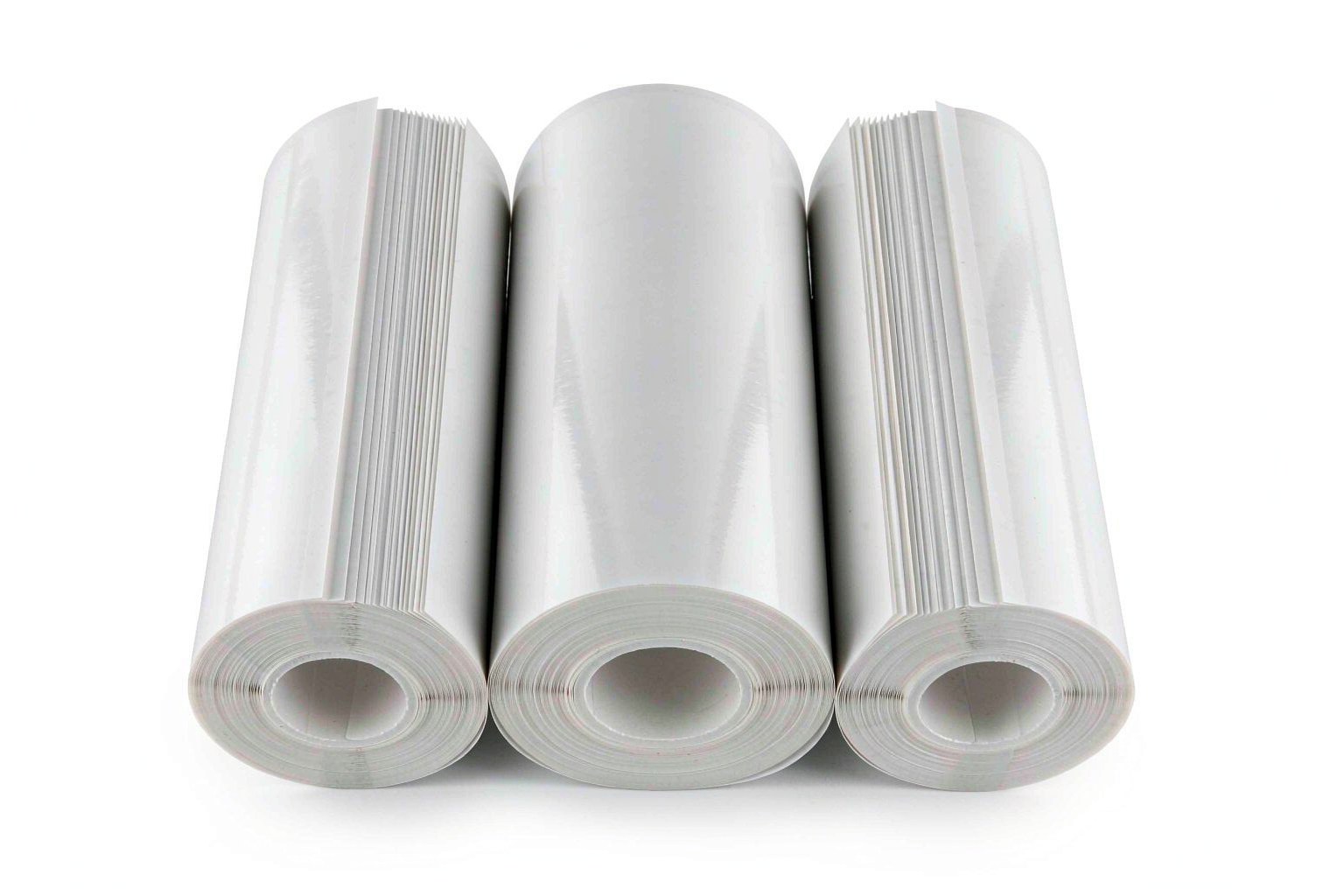
The combinations below are the ones we are asked for most often. Base and PE weights are quoted against the job rather than held as fixed catalogue codes, because a liner is specified by its build: change the base or the PE weight and it is a different product.
| Build | Base paper | Polyethylene | Typical use |
|---|---|---|---|
| Standard barrier liner | Kraft 60–70 gsm | 15 gsm, one side | General label work in humid climates; the cost-efficient default |
| Heavier barrier liner | Kraft 80–90 gsm | 20–25 gsm, one side | Larger labels and high-speed dispensing where a stiffer web is wanted |
| Two-side coated liner | Kraft 80 gsm | 15 gsm per side | Maximum barrier where both faces are exposed — sheeted work, fanfold |
| Printable liner back | Coated art paper 80–100 gsm | 20 gsm, one side | Brand or handling print on the reverse of the release paper |
| Stock alternative | Glassine 54 / 60 / 80 gsm | None (silicone direct) | Thin, cheap, dies cleanly; the answer when humidity is not the problem |
Thickness, release value and roll format are set per order: tell us the adhesive you are running and we will match the release to it, because release is a property of the silicone–adhesive pair, not of the liner alone.
Because a poly-coated liner is quoted per build, the fastest way to see what "good" looks like is to look at the liners we already ship on stock constructions. These five cover the range from thin and cheap to a genuine moisture barrier.
| Code | Facestock | Adhesive | Liner | When this liner is the right answer |
|---|---|---|---|---|
| FL0101W21 | 70 gsm woodfree paper | Hot-melt | 54 gsm white glassine | Short web paths and dry climates; the cheapest thing that dies cleanly |
| UV0101W21 | 140 gsm semi-glossy cast coated paper | 23 ± 3 mic | 60 gsm white glassine | General-purpose digital paper work; the everyday paper liner |
| MJ0401W21 | 75 mic glossy white PET film | Water-based permanent acrylic | 80 gsm glassine | Stiffer web for high-speed dispensing and larger formats |
| FL0301W21 | 60 mic glossy white PET film | Water-based | 135 gsm white liner | Maximum stiffness; still paper, so a poly build is the upgrade if humidity is the issue |
| FL0215W21 | 80 mic glossy white BOPP film | Water-based | 30 mic transparent PET film | The true barrier — and the only transparent option, for clear-on-clear work |
If your job fails on curl rather than on cost, compare the 54 gsm row with the PET film row first: the difference between them is exactly what a poly-coated build buys you, at a caliper between the two.
Nearly every enquiry that ends in a poly-coated liner starts with one of these complaints. Worth checking which one is actually yours, because two of them are storage problems rather than material problems.
Symptom: the web lifts, the finished roll relaxes after a week, print-to-die registration moves. Cause: a paper liner taking up moisture on one face. Fix, in order of cost: condition the rolls in the press room for 24 hours, store them flat and wrapped, then move to a poly-coated or PET liner. A barrier liner solves it too — it is simply the most expensive of the four options.
Symptom: the polyethylene lifts from the paper as a thin film, usually at the edge of the roll. Cause: weak anchorage between the extruded layer and the base sheet — extrusion needs the right melt temperature, line speed and surface treatment, and a soft or dusty kraft base makes it harder. Fix: this is a supplier-side process problem. Send us the roll; we compare it against the retained sample.
Symptom: one side of the web peels harder than the other. Cause: silicone applied over a PE layer that varies in thickness or surface energy across the web. Fix: poly-coated liners need the silicone anchored to the film, not sitting on it — check the coat weight profile with us before blaming the adhesive.
Symptom: sheets stick together, sheet-fed jobs double-feed, rolls leave adhesive on the liner back. Cause: adhesive ooze under winding or stacking pressure, made worse by heat and humidity. Fix: check slitting quality and winding tension first; a stiffer liner genuinely helps because it resists the pressure that pushes adhesive sideways.
"PE-coated kraft liner" on its own describes four or five different materials, which is why two suppliers can both confirm the spec and ship different rolls. Put these six lines on the purchase specification and the ambiguity disappears: base paper type and grammage, polyethylene grammage and which side or sides, silicone release value measured against your adhesive, liner caliper or total grammage, roll width and core, and the storage conditions the material must survive before use.
The last one is the one buyers forget, and it is the one the barrier exists for. If the roll spends six weeks in a container before it reaches your press, say so — that single sentence changes the recommendation more than any other.
Answered by the coating and conversion team, not by marketing.
54, 60 and 80 gsm compared — the stock liner most jobs should specify, and when to leave it.
Cold-chain jobs combine a humidity problem with a low-temperature problem; the liner is only half of it.
If the liner is a laser stop layer, a PE film changes the energy balance — validate before you commit.
Ice buckets and wet coolers are where an unsealed liner shows up as edge lift.
Send the destination port, the storage conditions and the adhesive; we will quote base and PE weights.