
The liner is the part of the label nobody looks at and the part that decides whether the line runs. Glassine weight sets the die-cut depth window, the stiffness of the web, how the label dispenses, and how much the finished roll curls.
Model guide · last verified 2026-10-21 · published in English · technical questions: contact the lab
Glassine is a supercalendered paper: wood pulp beaten to a high degree of fibrillation, then pressed and polished between calender rolls until the surface closes. The result is dense, smooth, translucent and — critically — low in air permeability. That matters because the release coating is applied as a thin film; a paper that lets air and moisture through will absorb silicone unevenly and release erratically.
It is still the default for three reasons: it is cheap, it dies cleanly, and it is stable enough for ordinary converting. Its limits are equally clear — it is not flat like a film, it absorbs moisture, and its thickness varies within a batch more than a PET liner does.
Those limits are exactly what you are managing when you choose between 54, 60 and 80 gsm.
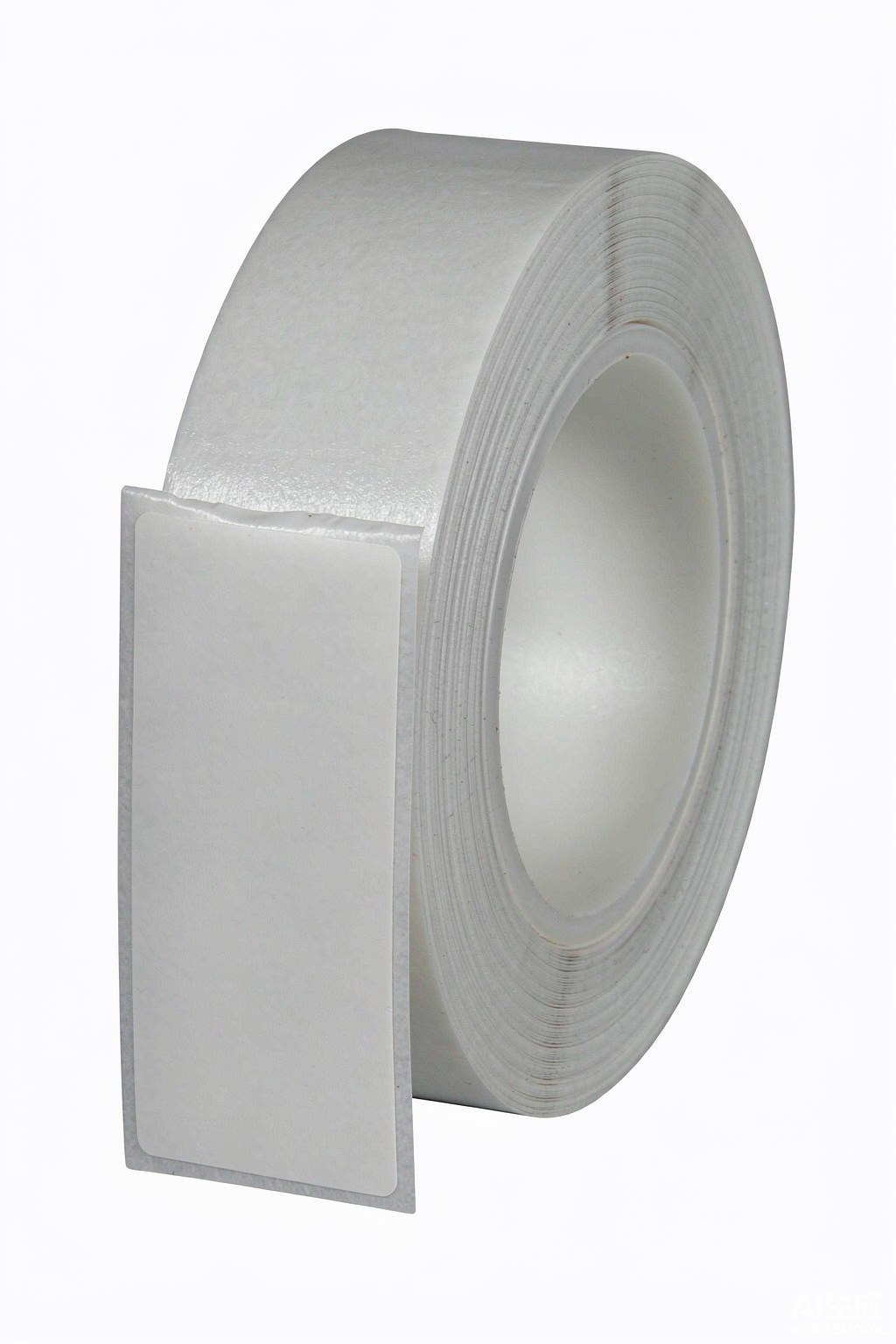
The table lists real constructions from our current range across four liner types. This is the most useful way to choose a liner: not in the abstract, but as the liner that comes with the facestock and adhesive you already need.
| Code | Facestock | Adhesive | Liner | Typical reason for this liner |
|---|---|---|---|---|
| FL0101W21 | 70 gsm woodfree paper | Hot-melt | 54 gsm white glassine | Thin, low-cost general purpose; short web paths |
| FL0103W21 | 80 gsm woodfree paper | Frozen | 54 gsm white glassine | Cold-chain labels where liner thickness is not the constraint |
| UV0101W21 | 140 gsm semi-glossy cast coated paper | 23 ± 3 mic | 60 gsm white glassine | General-purpose digital paper: the everyday 60 gsm case |
| MJ0401W21 | 75 mic glossy white PET film | Water-based permanent acrylic | 80 gsm glassine | Stiffer web for inkjet film labels and larger formats |
| FL0301W21 | 60 mic glossy white PET film | Water-based | 135 gsm white liner | Heavy coated paper liner: maximum stiffness and a wide die-cut window |
| FL0215W21 | 80 mic glossy white BOPP film | Water-based | 30 mic transparent PET film | Transparent, dimensionally stable liner for clear-on-clear work |

Liner weight is not a quality grade — heavier is not automatically better. It is a trade between stiffness and cost, and the right answer depends on the label size, the line speed and the container.
| If this is your situation | Start with | Because |
|---|---|---|
| Small labels, short web path, cost sensitive | 54 gsm glassine (FL0101W21) | Thinner liner is cheaper per m² and dies cleanly at moderate speed |
| General converting, mixed jobs | 60 gsm glassine (UV0101W21, FL0310W21) | The default balance of stiffness, cost and die-cut window |
| High-speed dispensing, large labels | 80 gsm glassine (MJ0401W21) or 135 gsm coated paper (FL0301W21) | A stiffer web resists stretching and keeps registration stable at speed |
| Clear-on-clear, no-label look | 30 mic transparent PET liner (FL0215W21) | A paper liner shows through clear film and is visible in the finished pack |
| Laser finishing or very thin facestock | 60–80 gsm glassine, or a PET film liner | The liner is the stop layer; too light or too porous and the beam breaks through |
| Long storage before use, humid climate | PET film liner, or a heavier glassine | Paper liners absorb moisture and curl; film liners do not |

Liner complaints are usually described as "bad material". In practice they are one of these four, and three are construction choices rather than defects.
Symptom: the web lifts or the finished roll opens up; registration drifts on press. Cause: a paper liner taking up moisture on one face, usually after storage in an unconditioned warehouse, aggravated by a thin 54 gsm liner. Fix: condition the rolls in the press room for 24 hours before running, store flat and wrapped, and consider an 80 gsm or PET liner for humid climates.
Symptom: sticky edges, blocked rolls, labels that will not feed. Cause: ooze is driven by the adhesive and the winding tension, but a light liner makes it visible sooner because there is less absorbent bulk to hide it. Fix: check slitting quality and winding tension first, then review the adhesive coat weight with us.
Symptom: the liner is scored, labels pre-release, or the web snaps at speed. Cause: the die-cut depth window is too narrow for a 54 gsm liner at that line speed, or the liner caliper varies within the batch. Fix: move up to 60 or 80 gsm glassine and re-set the die; a heavier liner widens the window rather than just adding cost.
Symptom: registration wanders, or the web tracks differently from the paper-liner job it replaced. Cause: film liners are smoother and more dimensionally stable than paper, so web handling parameters that were tuned for paper are now wrong. Fix: re-tension the web and re-check nip pressure — it is not a material fault, but it is a real project cost when switching liner type.
Release force depends on the silicone system, the adhesive chemistry and the age of the roll, not only on the liner. We do not publish a single release number, because a number taken out of context invites exactly the wrong comparison between two suppliers.
What we do is state the liner grade and the adhesive on every TDS, run the same five batch tests (initial tack, holding power, 180-degree peel, climate ageing, coating inspection), and keep retained samples for the life of the batch. If a roll performs differently from the sample you approved, we can compare it against the retained sample rather than argue about it.
Answered by the coating and conversion team, not by marketing.
The liner is the stop layer under a laser — this is where liner choice stops being a cost decision.
On aqueous inkjet film, the coating and the liner together decide print quality and runnability.
124 flexo constructions with their liner grade stated on every data sheet.
Five batch tests, retained samples, and how the 1080 mm line is run.
Send the label size, line speed and climate; we will come back with a construction, not a catalogue.
Width, length, OD and core — how the liner weight changes a roll and how to inspect a delivery.
When dense glassine is still not sealed enough: base paper, PE weight per side, and how to write the spec.