
A tamper-evident label is judged by one thing: what is left behind when someone peels it. Everything else — the film, the adhesive, the print — is there to make that one moment predictable. Most VOID specifications fail because the buyer names a colour and a size, and never names the transfer type.
Model guide · last verified 2026-10-21 · published in English · technical questions: contact the lab
A VOID construction has one extra layer compared with ordinary labelstock: a release interface buried inside the material, printed with the hidden message. The film and the adhesive are bonded to opposite faces of that interface. Under normal handling the assembly behaves like one solid sheet. When it is peeled, the interface is the weakest plane in the stack, so it separates — and the message is revealed in whichever direction the interface was designed to fail.
That is the whole mechanism, and it explains every specification decision that follows. The transfer type is not a property of the adhesive; it is a property of where that buried interface sits and how strongly each of its faces is anchored. This is why the same acrylic adhesive can appear in all three products, and why asking for "a strong VOID material" without naming the transfer type gets you a sample that may do the opposite of what you want.
It also explains the second failure people rarely plan for: the interface separates at temperatures and pressures the label meets in storage, not only when someone peels it. A roll left in a hot van, or a stack of cartons under load in a container, can pre-trigger a VOID message before the product ever reaches the customer.

The three constructions exist because three different customers need to look at three different surfaces after a tamper attempt. Choose the one that matches who inspects what.
| Transfer type | After removal | Best for | Do not use it when |
|---|---|---|---|
| Full transfer | The whole security layer and the message stay on the substrate; the removed film is left clear | Cartons, warranty seals, high-value packaging where permanent visible residue is the point | The substrate is recycled, reused or has to look clean afterwards |
| Partial transfer | Evidence appears on both the film and the substrate | Logistics and electronics sealing where an operator needs to inspect both surfaces | You need one unambiguous surface of evidence — splitting it can confuse a claim |
| Non-transfer | The message stays on the removed film; the substrate is left essentially clean | Glass, painted metal, screens, returnable and premium surfaces | A visible mark on the product surface is what your process relies on |

VOID material is made to order rather than held as a catalogue code, so the specification is the product. These are the parameters that decide whether two suppliers are quoting the same thing — the numbers below are the ones this construction is normally quoted against, and we confirm the exact values on the sample and the TDS for the lot you receive.
| Parameter | What is normally quoted | Why you have to name it |
|---|---|---|
| Transfer type | Full / partial / non-transfer | Decides where the evidence appears; not interchangeable after printing |
| Facestock | PET 25, 36 or 50 micron | Thinner film conforms better to curved and textured surfaces; thicker film resists scuffing and stays flatter on large labels |
| Surface finish | Silver, white or transparent, gloss or matte | Silver hides handling marks best; white prints cleanest; transparent is the hardest to apply without trapped air |
| Hidden message | VOID, OPEN VOID, VOIDOPEN, or custom text / logo | Custom artwork needs a plate or digital setup, so it changes the lead time, not just the price |
| Adhesive | Acrylic, around 20 gsm, permanent | Must be matched to the substrate energy; a firm acrylic that grips steel can fail on untreated PE |
| Liner | 80 gsm white glassine | Controls die-cutting and dispensing; a thin liner curls on large labels in dry rooms |
| Format | Jumbo roll, slit roll, or sheets | Roll width and winding direction must match your press, or the material is unusable whatever its specification |
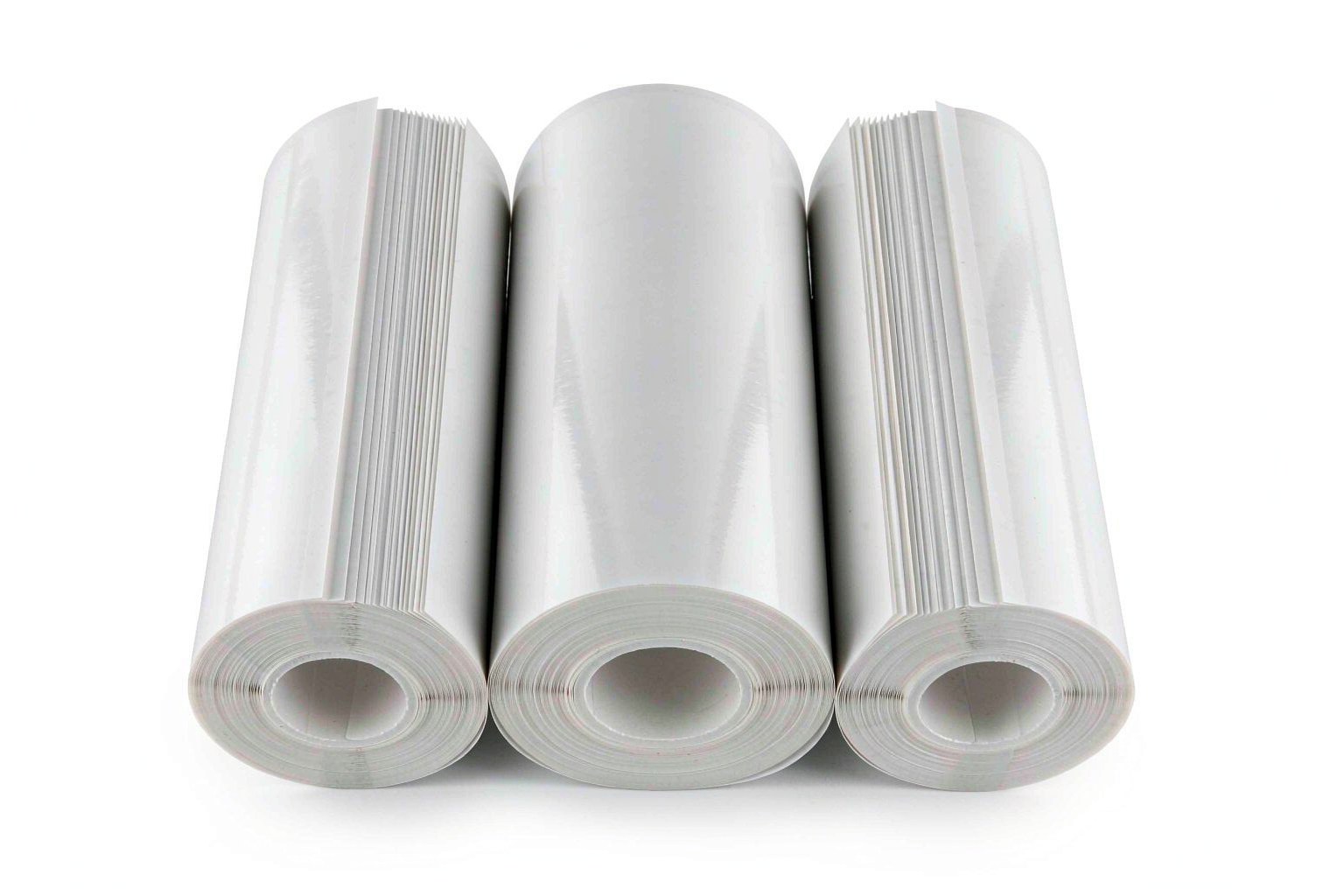
Most VOID work is made to order, but one construction sits in our range as a published code, because it covers the majority of carton and warranty-seal jobs. Everything below is from the product record, not from a brochure.
| Code | Construction | Adhesive | Liner | Transfer type |
|---|---|---|---|---|
| NE0103W21 | 25 micron matte silver anti-counterfeit VOID film | Oil-based permanent | 80 gsm white glassine | Full transfer (positive version) |
"Positive version" means the message is printed so that it reads correctly on the surface after removal, rather than mirror-reversed on the film. If your inspection process reads the removed film instead of the pack, say so before we quote — it is a different build.
These are the calls we get. None of them is a manufacturing defect in the usual sense — each is a specification that did not name something.
Symptom: the film lifts as one piece and the carton shows nothing. Cause is almost always substrate energy, not the material — the adhesive never built enough anchorage to pull the interface apart, so the peel simply ran along the adhesive. Untreated PE and PP, silicone-contaminated board and dusty recycled corrugate all do this. Fix: confirm the substrate and its surface energy before approving the sample, and corona-treat or switch to a higher-anchorage adhesive if it is below roughly 38 dyn/cm.
Symptom: the message is already faintly visible on labels straight off the roll, or a stack of sealed cartons shows ghosting. Cause is pressure and heat in storage — a roll wound too tight, a pallet stacked high, or a container that sat in the sun. Fix: specify the winding tension and roll diameter for the film thickness, and keep VOID rolls out of hot storage. This is a supply and handling conversation, not a material change.
Symptom: evidence is there but the word is patchy or half-missing. Two causes: a rough or fibrous substrate that only contacts the high points of the adhesive, and a full transfer construction chosen for a textured surface. Fix: use partial transfer on textured board, or increase application pressure and dwell so the adhesive wets the whole footprint.
Symptom: the customer wanted a clean product and got adhesive residue, or wanted obvious evidence on the product and got a clean surface. This is a transfer-type mismatch, and it cannot be fixed downstream — it has to be caught at the sample stage. Send us the actual product, not a photograph of it.
A VOID label is only as good as the bond under the interface. Two surfaces that look identical in a photograph behave differently: a painted metal panel and an anodised one are different substrates, and so are two grades of corrugate. Surface energy is the number that matters, and below roughly 36 to 38 dyn/cm most acrylics will not anchor reliably without treatment — polypropylene sits near 29 and polyethylene near 31, which is why untreated plastic crates and PE bags are the classic silent failure.
Curvature and texture come second. On a tight radius the film has to conform without lifting at the edge, which pushes you thinner; on a rough surface the adhesive has to wet the high points, which pushes you to a softer, higher-coat-weight adhesive. Those two demands conflict, and that is exactly the conversation to have before the sample is approved rather than after the first container.
Cold is the third variable. Applying a tamper seal to a chilled or frosted surface is a freezer-adhesive problem, not a security problem — a standard acrylic applied at 0 °C builds no anchorage at all, so the seal looks fine and fails silently in transit.
VOID film is printed on the face, never over the edge. Thermal transfer with a resin or wax-resin ribbon is the usual route for variable data because a wax ribbon scuffs off a security label faster than it scuffs off paper; UV offset and screen are common for the fixed artwork. A topcoat helps ink adhesion on PET and costs less than a rejected lot.
Die-cutting is where most first runs lose material. The cut has to go through the film and the security layer but stop in the liner, and the security layer is softer than ordinary labelstock — so a die that is correctly set for paper will often nick the interface. Ask for the material to be run on the press before the artwork is finalised, not after.
Finally, storage: VOID is one of the few label materials where the roll itself is a consumable. Keep it out of direct sun, out of hot vehicles, and use it within the shelf life stated on the TDS rather than carrying it over from one season to the next.
Answered by the coating and conversion team, not by marketing.
Where tamper evidence meets a compliance pack: small formats, variable data and serialisation.
Carton seals and shipping labels on the same pallet; the direct-thermal grades are covered there.
The opposite requirement — clean removal rather than deliberate evidence.
Security labels are small and densely packed, so dispensing consistency starts with the liner.
Tamper-evident and void constructions usually carry a solvent acrylic: dense film, no emulsifier, higher ultimate adhesion.
Tell us the exact surface and the transfer type; we will answer with a construction, not a brochure.