
Solvent acrylic is the system buyers reach for when the label has to survive something — a chemical, a wash-down, a plasticiser, a hot fill. It is also the system most often specified on the wrong facestock, because the reason it works is not the adhesive alone.
Model guide · last verified 2026-10-21 · published in English · technical questions: contact the lab
A water-based acrylic is a polymer dispersed in water with the help of surfactants. When it dries, the water leaves, the particles coalesce into a film, and the surfactant stays — a small but permanent fraction of the adhesive is not adhesive at all. A solvent acrylic is a polymer dissolved in an organic carrier. There are no particles to coalesce and no surfactant to leave behind: the carrier evaporates and what remains is a continuous polymer film.
That single structural difference explains almost everything downstream. A continuous film has lower and more predictable permeability, so mobile species in the substrate — plasticiser from a PVC bottle, oil from a carton, fragrance from a cosmetic — diffuse into it more slowly. It also has fewer water-sensitive residues, so prolonged humidity affects it less. Those are the two reasons the system is specified for chemical and wash-down duty.
The cost is in the drying tunnel. Organic carriers have to be driven off and recovered, which takes more energy and more dwell time per metre than evaporating water. That is why solvent coating runs at a higher unit cost, and why the minimum economical run on any line is longer than for water-based.

This is worth stating plainly because it is the most common sourcing question we get. Across our current range of 115 constructions, 51 use a water-based acrylic system and 17 use hot-melt. Sixteen use solvent acrylic — and every one of those sixteen is coated on PET, BOPP or PE film. There is not a single paper-faced solvent construction.
It is not a gap in the range. Organic carriers wet non-polar film surfaces cleanly, which gives a more uniform coat weight on PET and BOPP than a water-based dispersion does without a primer. On an open, absorbent paper the same carrier soaks in before it can be metered, so the coat weight becomes unpredictable and the economics collapse. Paper also brings no benefit that would justify the cost: the applications where pore blocking matters are film applications.
The practical consequence for a buyer is simple. If someone quotes you a solvent acrylic on a cast-coated paper, ask what the coat weight tolerance actually is. On a film we hold it comfortably; on paper the same system is fighting the substrate.
| Facestock family | Constructions in range | Typical adhesive | Why |
|---|---|---|---|
| PET film (clear, white, metallised) | 11 | Solvent acrylic | Non-polar surface wets cleanly; dimensional stability through the tunnel |
| BOPP film (gloss white, pearl white) | 4 | Solvent acrylic | Same wetting advantage; pearl grades need an even coat for opacity |
| PE film | 1 | Solvent | Soft film, low coating tension, solvent carrier preferred |
| Paper (cast coated, semi-gloss, woodfree) | 0 | Water-based or hot-melt | Absorbent surface makes solvent coat weight unpredictable |
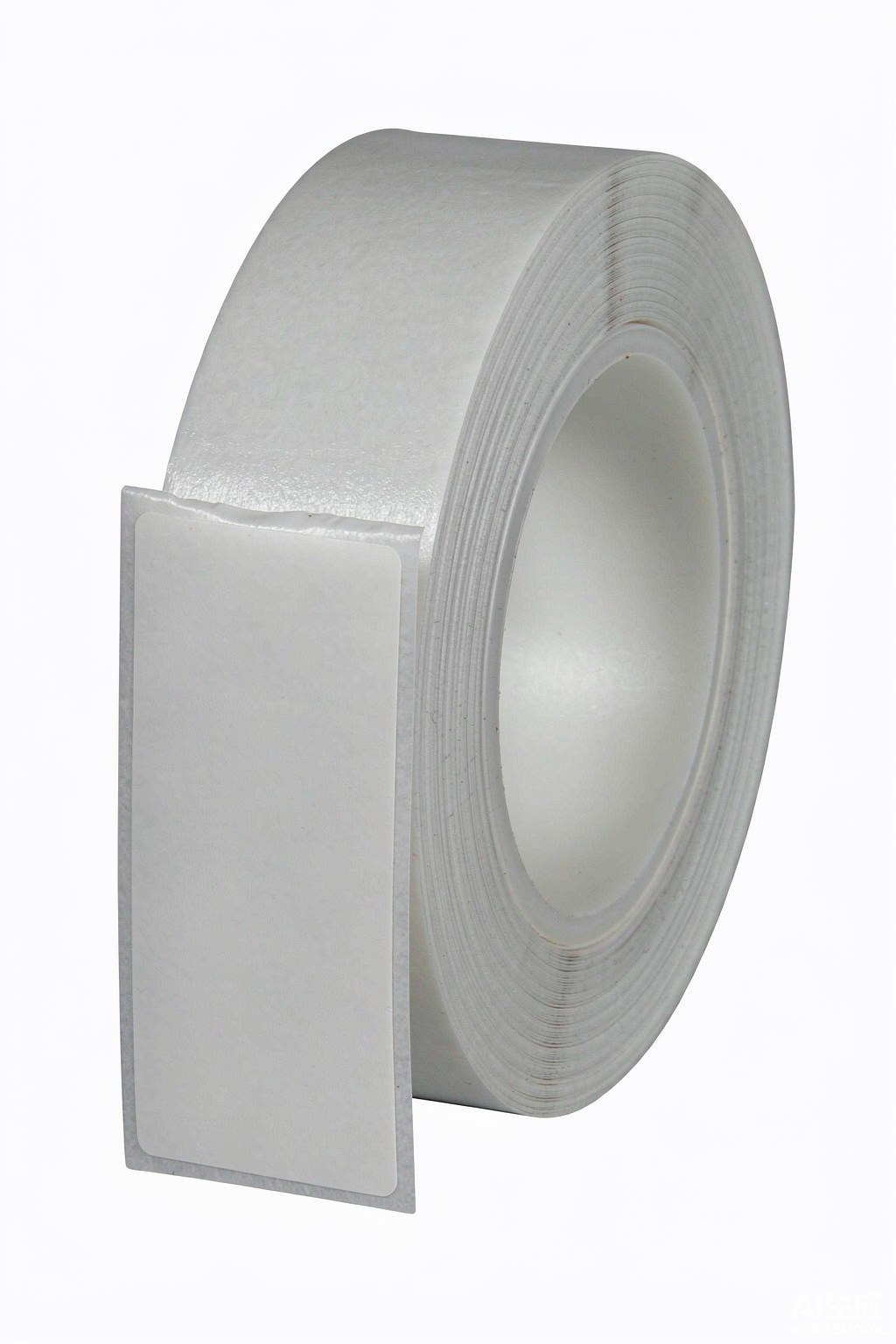
The table below is the actual range, not a sample. Thickness runs from 36 to 100 micron, liners are 60 or 80 gsm glassine, and every construction can be slit to your required width off the 1,080 mm master. Codes are our internal references — quote them and there is no ambiguity about which construction you are asking about.
| Code | Facestock | Thickness | Liner | Press family |
|---|---|---|---|---|
| MJ0503W21 | Clear PET film | 100 µm | 80 gsm glassine | Memjet |
| MJ0602W21 | Brushed gold / glossy silver PET | 36 µm | 80 gsm glassine | Memjet |
| MJ0701W21 | Glossy silver PET | 50 µm | 80 gsm glassine | Memjet |
| MJ0702W21 | Glossy silver PET | 80 µm | 80 gsm glassine | Memjet |
| MJ0801W21 | Pearl white BOPP | 36 µm | 80 gsm glassine | Memjet |
| FL0206W21 | Glossy white BOPP | 100 µm | 60 gsm glassine | Flexo |
| FL0208W21 | Glossy white BOPP | 75 µm | 60 gsm glassine | Flexo |
| FL0212W21 | Glossy white BOPP | 60 µm | 60 gsm glassine | Flexo |
| FL0304W21 | Glossy white PET | 60 µm | 80 gsm glassine | Flexo |
| FL0305W21 | Glossy white PET | 80 µm | 60 gsm glassine | Flexo |
| FL0311W21 | Glossy white PET | 36 µm | 60 gsm glassine | Flexo |
| FL0312W21 | Glossy white PET | 75 µm | 80 gsm glassine | Flexo |
| FL0313W21 | Glossy white PET | 60 µm | 80 gsm glassine | Flexo |
| FL0318W21 | Glossy white PET | 60 µm | 80 gsm glassine | Flexo |
| OF0108W21 | Matte silver PET (sheets) | — | 80 gsm glassine | Offset |
| NE0102W21 | White PE film | 100 µm | 60 gsm glassine | New Explore |
The reason buyers ask for solvent acrylic by name is chemical resistance. It is worth being precise about where that resistance comes from and where it stops.
What the system genuinely helps with is resistance to migration and to moderate chemical exposure. Because the dried film is continuous and carries no surfactant residue, plasticisers, oils and fragrance compounds diffuse through it more slowly than through a water-based acrylic. The same structure resists swelling in short contact with alcohols, mild acids and typical aqueous cleaning agents better than an emulsion system does. This is a difference in mechanism, and it is real.
What it does not promise is a number. There is no such thing as "solvent acrylic resists chemical X" in the abstract — resistance depends on the specific chemical, its concentration, the contact time, the temperature, and the facestock and print beneath it. A construction that survives a wipe-down with 70% ethanol can fail after 24 hours of immersion in the same fluid. We do not publish resistance tables for this reason: a table that is right for one customer's product is misleading for the next one.
The honest procedure is a test on your own product. Take the finished labelled item, expose it to the actual chemical at the actual concentration and temperature, and inspect at 1 hour, 24 hours and 72 hours for edge lift, blistering, softening and adhesive transfer. We supply free sample rolls for exactly this purpose, and we will tell you which of the 16 constructions is the sensible starting point — but the pass or fail belongs to your test, not to our datasheet.
The three systems are not better or worse than each other; they are wrong for each other's jobs. The table sets out where each one earns its place in a 115-construction range.
| Solvent acrylic | Water-based acrylic | Hot-melt | |
|---|---|---|---|
| Constructions in our range | 16 | 51 | 17 |
| Facestock fit | PET, BOPP, PE film | Paper and film | Paper and film |
| Chemical / plasticiser resistance | Best of the three | Moderate | Moderate |
| Initial tack | High, builds fast | Moderate | Highest |
| Low-temperature performance | Good | Limited | Poor below freezing |
| Unit cost | Highest | Lowest | Low–moderate |
| Minimum economical run | Longest (drying tunnel) | Short | Short |
| Typical use | Chemical, wash-down, pharma, cosmetic | General paper and film labels | High-volume paper, chilled goods |
Most of the cost of a wrong adhesive choice is paid at the filling line, not at purchasing. Four cases where we steer buyers away from solvent systems:
You are optimising for price on a short run. Solvent acrylic costs more per square metre than water-based, and the gap is widest on small orders because the drying tunnel has to be brought up to condition either way. If the label is functional and the environment is ordinary, water-based is the correct specification.
The application is deep-freeze. Solvent acrylic is not a freezer system. Below roughly −20 °C the adhesive loses tack faster than a dedicated freezer-grade acrylic, and labels applied cold will lift at the edges. Use the freezer-grade constructions instead.
The label has to come off again. Solvent systems in this range are permanent. If the label must be removable — promotions, price changes, returnable assets — a removable acrylic is the right call regardless of chemical exposure.
You need maximum initial tack on a rough or fibrous surface. That is a high-tack job, and high-tack systems are formulated for it. A solvent acrylic on a rough board will still need pressure and dwell to wet out.
Solvent acrylic enquiries that go wrong almost always go wrong on five fields. Give us these and the quote is precise the first time:
1. The chemical and the exposure. Name the substance, the concentration, the contact time and the temperature. "Resists chemicals" cannot be quoted; "wiped with 70% ethanol at 20 °C, four times a shift" can.
2. The facestock and thickness. If you have been buying 60 µm glossy white PET, say so — the difference between 36 and 100 µm changes stiffness, conformability and cost more than most buyers expect.
3. The application temperature and the service temperature. Applied at 5 °C or at 25 °C changes the recommendation even for the same end use.
4. The liner and the die-cutting method. 60 gsm glassine cuts and dispenses differently from 80 gsm, and laser die cutting constrains the liner choice further.
5. The order quantity and required width. Our MOQ is 1,000 m²; master width is 1,080 mm and we slit to order. Lead time is 15–25 days depending on construction and slitting programme.
Answered by the coating and conversion team, not by marketing.
The BOPP side of the film range, including the pearl white grade used with solvent acrylic.
If the application is deep-freeze rather than chemical duty, this is the system to read first.
For labels that have to come off again — the common reason a solvent system is the wrong choice.
Where solvent acrylic usually sits in a pharmaceutical pack, and what documentation goes with it.
60 and 80 gsm glassine compared — the two liners used across all 16 solvent constructions.
The wider decision: five adhesive families matched to surface, temperature and removal.