
Direct Thermal Label Material for Hot Climates: A Spec Guide
A direct thermal roll that prints grey, or prints a barcode your scanner refuses at the far end of the conveyor, has usually been damaged before it ever reached the printer. The coating reacts to any heat source, not only the printhead, and a steel container crossing the South Atlantic in January, or a warehouse with an uninsulated metal roof outside Jeddah, holds enough heat for long enough to lift background density across the whole web. The remedy is a specification decision — a top-coated grade, a 60 gsm glassine liner, a declared transit condition — rather than a cheaper roll.
This article is for the buyer who has already seen the problem once: a pallet that printed well in the supplier's sample room and printed like a third-generation photocopy six weeks later.
What a direct thermal coating is doing, and why heat only goes one way
Direct thermal paper carries a coating of three things: a colourless leuco dye, a developer, and a sensitiser that lowers the temperature at which the other two react. The printhead pushes a tiny element to somewhere around 200–300 °C for a few milliseconds; the developer melts, meets the dye, and the dye opens into its coloured form. No ribbon, no ink, no consumable except the paper itself — which is exactly why the format dominates transport labelling.
The problem is that the chemistry cannot distinguish between the printhead and a container roof. It is a threshold reaction with a time term attached. A printhead delivers an enormous temperature for a few milliseconds; a container delivers a moderate temperature for forty days. Both move the same reaction forward, and the second one moves it everywhere at once, including the spaces between the bars of your barcode.
Two failure directions get confused in complaints, and they need separating because they have different causes.
- Darkening. The background goes grey, then muddy brown. Contrast between bar and space collapses and the scanner stops decoding. This is cumulative heat, and it is the failure that starts in transit.
- Bleaching out. The printed image disappears while the background stays white. This is light, plasticiser or solvent — clear packing tape, PVC sleeves, hand sanitiser, oily hands, shrink film. It is a barrier problem, not a temperature problem.
A topcoat addresses the second failure far better than the first. That distinction matters later, when a supplier offers "top-coated" as the answer to a container that ran at 58 °C for five weeks: it is not the same problem, and the topcoat will not buy you a month.
Three heat paths a roll passes through before your printer
Buyers tend to think of "storage" as the month the material spends in their own racking. In practice the material is exposed three times before that, and the worst exposure is usually the one nobody photographed.
The container. A steel box standing in the sun with the doors shut behaves like an oven with no thermostat. Interior air commonly runs 20–30 °C above ambient, so a 35 °C day at the port of loading puts the air inside somewhere near 60 °C, and the cartons stacked under the roof run hotter still. Asia to Santos or Suape is typically 30–40 days door to door; Asia to Jebel Ali around 20–25; intra-Asia to Port Klang or Ho Chi Minh City as little as a week. The shorter routes are not automatically safe, because the material may sit in a yard at either end for another fortnight.
The port and the customs yard. This segment has no temperature story at all. Containers wait, are opened for inspection, closed again, and cartons are sometimes staged on the quay in direct sun. If you buy FOB, the material's thermal history after the vessel sails belongs to a custody chain nobody in your buying office can see.
Your own warehouse. An uninsulated metal roof radiates onto the top tier of racking, which is where the new pallet goes because it is the only free space. A roll that spent five weeks in a container and three more under that roof has been cooked twice.
The damage rarely arrives as a material claim. It arrives as a rejected inbound at a 3PL, a relabel shift, a chargeback, or a driver who cannot scan at the gate — and by the time anyone measures background density, the pallet has already been consumed.
Topcoat is the specification that decides, not the price per square metre
A topcoat is a thin film — typically a gram or two per square metre dry — applied over the thermal layer. It does three things: it smooths the surface so the printhead makes even contact, it reduces head wear, and it puts a barrier between the reactive layer and the world. The third is what sales literature talks about, and it is real: a top-coated sheet resists hand oils, condensate and the plasticiser in a shrink sleeve far better than a bare surface.
What a topcoat does not do is reverse heat that has already been absorbed. If the background density has risen in the container, it has risen in the coating beneath the topcoat, and no downstream process takes it back out. This is why the grade question and the transit question have to be answered together — the same conversation, not two purchase orders.
The liner is the second half of that conversation and it is usually ignored. Thermal labelstock is dispensed at speed by an applicator that senses the gap between labels, and a 60 gsm white glassine liner gives the combination of stiffness, opacity and calliper consistency that those sensors and that die need. A lighter liner saves money per square metre and then costs it back in web breaks and misregistration; a film liner solves humidity but changes the die-setting window. If your converter is running a rotary die-cutter, the liner calliper is part of the tooling calculation, not a packaging detail. Our glassine liner guide covers the calliper and release-force side in more detail.
| Grade | What sits on the face | Code in our flexo range | Typical unprinted shelf life | Where it belongs | Where it fails |
|---|---|---|---|---|---|
| Uncoated direct thermal | Thermal layer only, 65–75 g/m² face | Not stocked | Around 6 months | Same-day picking labels, in-store price marking, receipts | Background lifts early in heat; damaged by a single hot container |
| Top-coated direct thermal | Thermal layer plus protective topcoat, 70 g/m² face | FL0109W21, FL0110W21, FL0111W21 — hot-melt adhesive, 60 gsm white glassine liner | Around 12 months | Transport labels, scale labels, 3PL picking in hot and humid markets | Still cumulative heat; rub and moisture resistance only |
| Direct thermal film | Thermal coating on white BOPP | Quoted per project | Longer than paper, still finite | Condensation, chilled and wet handling, poly mailers | Cost; adhesive must suit low-energy plastic surfaces |
| Thermal transfer paper | Plain coated paper, image from a wax or wax-resin ribbon | From the flexo and offset ranges | Years once printed | Anything archived, audited or exposed to sun | Needs a ribbon and a different printer; not a drop-in change |
Coating 1,080 mm wide at 180 m/min: why the edge of the web tells the truth
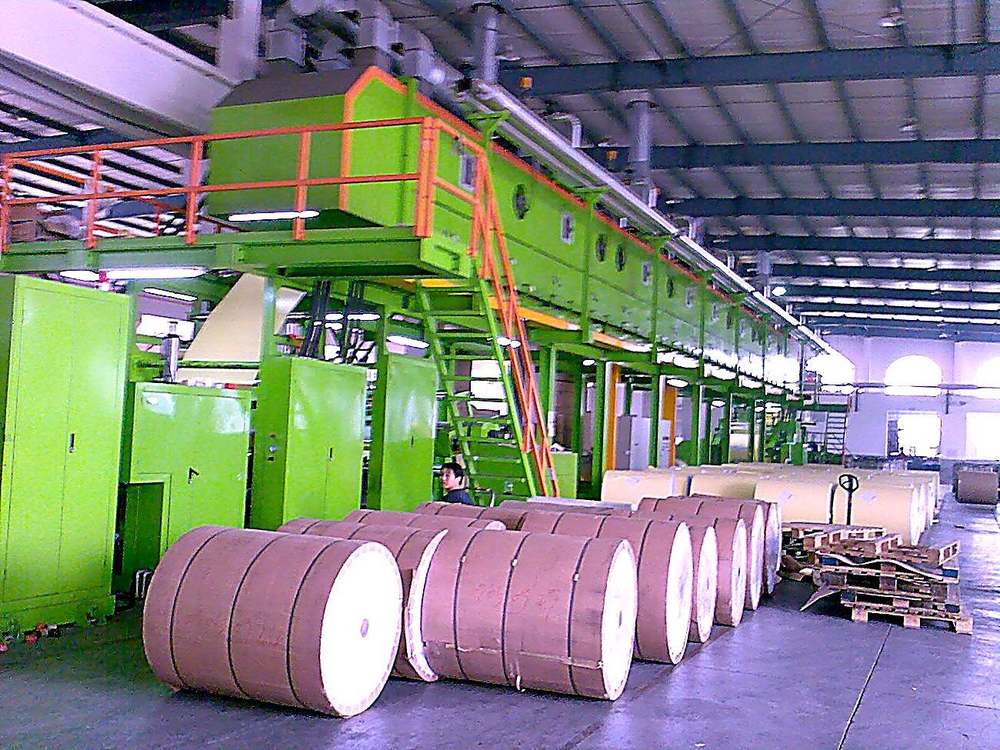
Thermal coating is unforgiving about uniformity because the failure is visual and cumulative. Our line coats a 1,080 mm web at up to 180 m/min, which means the wet film crosses the drying tunnel in a matter of seconds and the water has to leave without taking the sensitivity with it. Run the tunnel too hot and you pre-develop a fraction of the coating before the roll is even wound: the material still prints, but its background starts a shade higher than the batch before it, and the difference will be blamed on the customer's printer three weeks later.
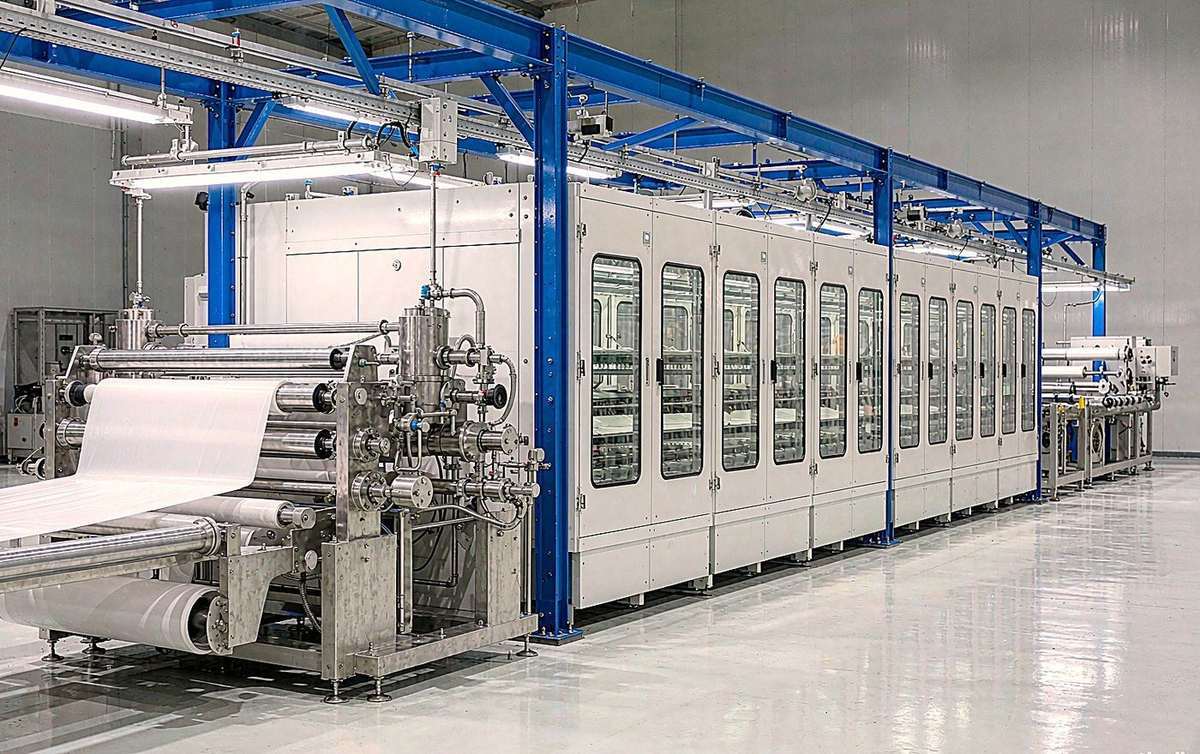
Width creates a second, quieter problem for the converter. A 1,080 mm master is slit into lanes, and the two outer lanes carry the edge trim — the part of the web that saw the most turbulence in the dryer and the most handling at the unwind. A converter running 100 mm lanes is buying five or six different positions across that web, and if the coat-weight profile drifts, the lanes do not behave identically. When one lane of a delivery prints lighter than the others, the useful question is which lane it came from, not which pallet.
This is also why we are careful about what "1,080 mm" means commercially. It is the coating width, not a promise that any width you ask for arrives with no trim loss, and it is not the same as a jumbo roll width in a catalogue. Buyers who need a specific finished width should state it, because the slitting plan is what determines how much of the master becomes saleable material. The layer structure and the coat weights behind these numbers are set out in our coating technology pages, and the flexo range that carries the thermal stock is listed on the product pages.
Five batch tests, and what each one would have caught
Every batch leaves the plant with five measurements recorded against it: initial tack, holding power, 180° peel, climate ageing, and coating appearance. None of them is a substitute for a forty-day container, but each one closes a specific way the material can go wrong.
Initial tack is measured as loop tack on a standard surface. For transport labelling it answers a narrow but expensive question: will the label stay on a recycled corrugated carton with a dusty, short-fibre surface, at the temperature of the application line? A tack figure that looks healthy on steel can still be marginal on board.
Holding power is a static shear test — a defined mass on a defined area, and the time until it slips. In hot markets this is the test that predicts edge ooze: an adhesive that holds at 23 °C can creep at 45 °C on a curved surface, and the label slides off the shoulder of a bottle or a drum.
180° peel measures how much force it takes to take the label back off, and, read alongside the failure mode, whether the adhesive is anchored to its own face material. Peel cleanly away and leave a ring of glue on the carton, and the number is meaningless: that is adhesive transfer, and the cause is the primer beneath the adhesive, not the adhesive itself.
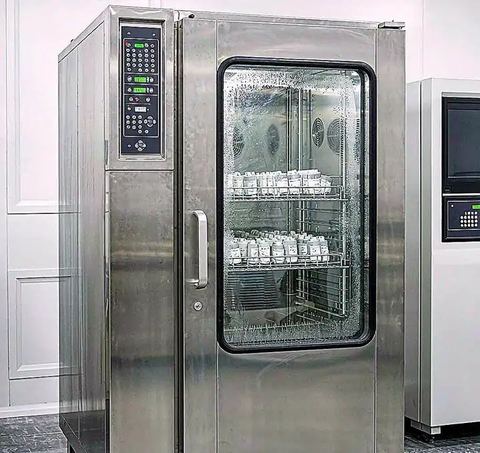
Climate ageing is the one that matters most for a hot-climate buyer, and the least understood. A laminate goes into the chamber at elevated temperature and humidity for a defined period, and is assessed afterwards on two things: whether the adhesive still behaves, and whether anything on the face has moved. For thermal stock the second reading is the one to ask about, because it is a direct proxy for the background density problem that ruins barcodes in the field.
Coating appearance is a visual and microscopic check across the web: pinholes, streaks, coat-weight bands, contamination, edge condition. On thermal stock a pinhole is not cosmetic. It is a spot where the printhead meets a different surface, and on a 100 × 150 mm label it is a hole in a barcode.
Surface energy explains a whole class of complaints that get filed as bad glue. Above roughly 36–38 dyn/cm a standard permanent acrylic wets out and bonds predictably. Untreated polypropylene sits around 29 dyn/cm and polyethylene around 31 — both below the threshold. A thermal label applied to a PP tote or a PE mailer is exactly that case, and no amount of extra adhesive fixes it; the adhesive beads instead of flowing into contact, the label holds on application, and it lifts two days later.
What belongs on the purchase order for a hot-climate destination
Most of the disputes we see are not about quality in the abstract; they are about a purchase order that specified a size and a quantity and left everything else to the supplier's default. Six clauses close most of the gap.
- Grade, named. "Top-coated direct thermal, 70 g/m² face" is a specification. "Thermal label paper" is a category, and the cheapest member of a category will be supplied.
- An ageing reading, not just a datasheet. Ask for the background density of the batch before and after the climate-ageing step, and for the method used. A supplier who cannot produce the second number has not measured it.
- Liner and core, stated. 60 gsm white glassine, core diameter and roll outside diameter, winding direction. These decide whether the roll runs on your applicator at all.
- Packaging and stowage. Moisture-barrier wrap rather than plain shrink film, palletised and banded, and a request that the pallets are not stowed directly under the container roof. A temperature logger in the door end of the container costs very little and ends the argument about what the material lived through.
- Shelf life and rotation. Unprinted direct thermal stock is commonly quoted at six to twelve months. Write the receipt date on the pallet and rotate first-in-first-out; the oldest pallet at the back of the rack is the one that fails.
- Who declares what. If the label goes onto food packaging, the food-contact question has to be answered by the party that can actually declare it. In the Gulf, GSO 1863/2013 was written to mirror EU 10/2011 — but it is a plastics standard, so a paper thermal label is not covered by it, and the paper, the adhesive and the topcoat have to be assessed against the framework they are actually declared under. Buyers who need phenol-free stock should say so explicitly: the EU restricted bisphenol A in thermal paper from January 2020, and "BPA-free" on a quotation is a claim that should come with a test report.
Then there is the arithmetic of a first order, where a good specification usually dies. Our minimum is 1,000 m² and production runs 15–25 days for stock constructions. At 100 × 150 mm, 1,000 m² is roughly 66,000 labels before gap allowance — enough to run a real qualification on two printers and still have stock for a month of live despatch. That is the right size for a trial; it is not enough to carry a national roll-out, so the second order has to be placed while the first is still being tested, not after it has passed. Lead time plus ocean transit is the number that decides whether you are qualifying material or rationing it.
The wider context — how the six layers interact and which one is responsible for which failure — is covered in the layer-by-layer article. If the material is being imported rather than bought locally, the export field guide covers the documentation and container side, and the technical library holds the data sheets and guides that go with a specification.
None of this makes direct thermal a bad choice for hot markets. It is the cheapest way to print a transport label and it will keep working there, provided the grade and the journey are specified together. What it will not survive is being bought as a commodity by the square metre and judged by a scanner in February.
FAQ
Can direct thermal labels survive a 35-day container crossing to Brazil?
They can, but the material that arrives is not the material that left, and the difference is decided by grade and stowage rather than by the datasheet. A top-coated grade stowed away from the container roof, with a temperature logger in the door end, will normally still print to readable contrast on arrival. A bare thermal roll that sat under the same roof may already carry a grey background. Inspect on receipt by printing a test patch and comparing it with a retained sample from the previous delivery, and reject the pallet before it enters stock if the background has moved.
At what temperature does direct thermal labelstock start to fail?
There is no single number, because the reaction carries a time term. Sustained heat in the 40s and low 50s Celsius over several weeks will lift background density enough to reduce barcode contrast, while a brief spike to a much higher temperature does far less damage. That is why a container standing in a tropical port for a month is a harder test than a lorry that reaches 70 °C for an hour on the way to a customer.
Is top-coated direct thermal always the right choice for a hot market?
No. A topcoat buys resistance to rubbing, moisture and plasticiser, which is what ruins labels after they have been applied, and it costs more per square metre; it does not undo heat that was absorbed in transit. For same-day picking labels that are scanned once, an uncoated grade is the economical answer. The case for a topcoat is a label that has to stay scannable through handling, condensation and months on a shelf.
Why did my thermal labels fade after someone taped over them?
Because clear packing tape and PVC sleeves contain plasticisers that migrate into the thermal coating and bleach the image, so the label goes white rather than grey. It is a chemical attack on the print rather than a printing fault, and no darkness setting recovers it. A topcoat slows the migration, but the real fix is to keep tape, PVC wallets and shrink film off the printed area and to protect the label with a paper or polypropylene sleeve instead.
What should a purchase order for hot-climate thermal labelstock specify?
At minimum: top-coated direct thermal at a stated face weight such as 70 g/m², the liner (60 gsm white glassine, with core and roll diameter), the background density before and after the climate-ageing step, moisture-barrier packing with pallets stowed away from the container roof, and a lot number on every roll. Add the food-contact declaration if the label touches food packaging, and state explicitly whether phenol-free stock is required.