
Pressure-Sensitive Labelstock, Layer by Layer: What Each of the Six Layers Decides

Almost every pressure-sensitive (PS) label material on the market is built from the same six layers in the same order. What separates suppliers is not the number of layers — it is the tolerance. How tightly the coat weight is held, how thoroughly the silicone cures, whether the liner still lies flat after six weeks in a humid warehouse. This is the layer-by-layer explanation our technical service team gives to converters who are qualifying us as a second source, including the parts that material suppliers usually leave out of the datasheet.
One clarification before the detail. There are two ways to buy label material. You can buy coated, unprinted labelstock — the raw laminated material on a roll, which your press then prints and die-cuts. Or you can buy printed labels, already converted. Everything below describes the first case. If your supplier is handing you a finished label and cannot tell you the coat weight of the adhesive, they are a converter, not a coater, and they are reselling someone else's construction.
The stack, from the face down to the liner
Read this table from top to bottom — it follows the physical order on the roll, and it is also roughly the order in which things go wrong.
| # | Layer | Typical specification we coat | What it actually decides | How it fails |
|---|---|---|---|---|
| 1 | Face material (facestock) | Semi-gloss cast-coated paper 80–160 g/m²; gloss or matt white BOPP 36–60 µm; clear PP; bright silver PET 23–50 µm | Print appearance, stiffness, opacity, moisture resistance, whether the label can be squeezed | Web wrinkling on the applicator; show-through on dark containers; edge curl in dry heat |
| 2 | Print-receptive topcoat | Water-based acrylic, 0.8–2.5 g/m² dry | Ink anchorage. The ink grips the topcoat, not the facestock | Ink rub-off, cracking along the die-cut line, weak colour density, poor wet trapping |
| 3 | Primer (adhesion promoter) | Solvent or water-based, under 0.5 g/m² dry | The bond between facestock and adhesive | Adhesive transfer — the label peels cleanly away and leaves a ring of glue on the product |
| 4 | Adhesive | Water-based acrylic 18–25 g/m²; hot-melt 18–22 g/m²; solvent acrylic; silicone | Wetting, initial tack, service temperature window, chemical and UV resistance | Edge lift, "pop-off" 24–72 hours after application, oozing at high temperature, yellowing outdoors |
| 5 | Release coating (silicone) | Solvent-free silicone, 0.6–1.2 g/m² | How much force it takes to lift the label off the liner | Too light — labels slide off in the press. Too tight — die-cut labels tear, or fly off the peeler plate |
| 6 | Liner (release liner) | 60–90 g/m² white or brown glassine; PET 23–36 µm | Dimensional stability, die-cutting register, matrix stripping, applicator speed | Liner curl in humid air; web breaks; ragged matrix that will not strip cleanly |
1. Face material: choose for the press first, the product second
The single most common mistake we see in incoming specifications is that the buyer picks the facestock from the product side — "it's a shampoo bottle, so we need film." That reasoning is half right. The press decides first, because a facestock that will not run on your press never reaches the bottle.
Paper and film behave differently on the press, and the difference is not print quality. It is web handling. A 60 µm BOPP film is roughly half the caliper of a 140 g/m² cast-coated paper and has a much lower stiffness; on a narrow-web flexo press with short web paths it will track beautifully, and on a long-web offset press with heavy tension it may wander. Conversely, paper on a high-speed rotary die-cutter with tight tension control can fracture along the grain.
Three rules that hold up in practice:
- Paper for cost and print feel. Cast-coated semi-gloss is the workhorse. It takes ink beautifully, it is opaque, and it is the cheapest way to get a premium-looking label.
- Film for anything the package has to survive. Water, oil, freezing, squeezing, abrasion, a shower. If the label must outlive the container in a wet environment, film is not optional.
- Look at the grain direction on paper. Paper has a machine direction. A label die-cut so the grain runs across the narrow dimension of the label will curl differently than one cut with the grain. On small labels applied at high speed this is the difference between a clean peeler transfer and a jam.
2. The topcoat is the layer buyers forget, and the layer that decides print quality
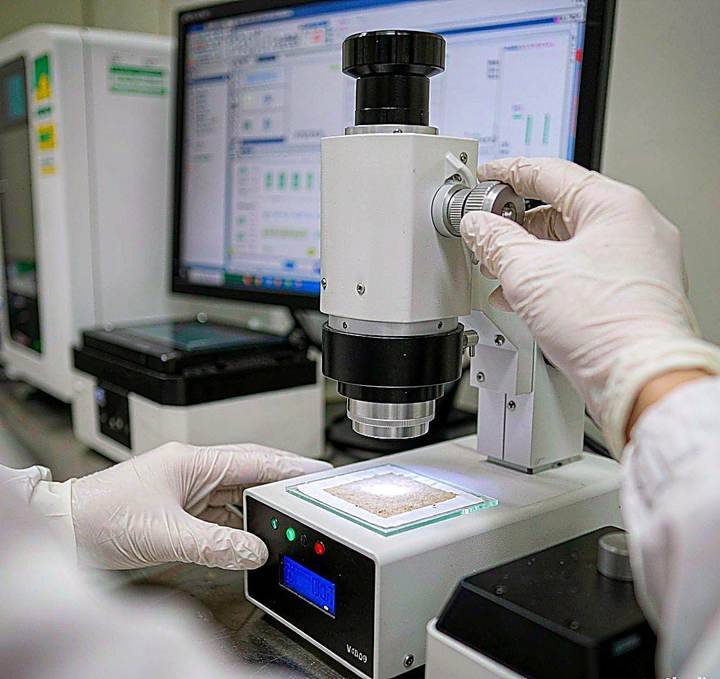
A UV inkjet or laser-printed label does not print onto paper or film. It prints onto a coating applied specifically to receive that ink. Change the topcoat and the same facestock goes from "vivid, sharp, rub-proof" to "washed out and scuffs off in the box."
This is why a facestock description alone is not a specification. "140 gsm semi-glossy cast coated paper" tells you nothing about whether the topcoat was formulated for UV-curable ink, for toner, or for water-based inkjet. Those three want different surface chemistry, and a construction optimised for one will underperform on the others.
We hold topcoat dry coat weight between 0.8 and 2.5 g/m² depending on the platform. Below that range the ink sits too close to the fibre and strikes through. Above it, the coating can become brittle and crack when the label is bent around a tight radius.
3. The primer: the cheapest layer, and the one that causes the ugliest failure
A primer is a thin tie-coat between the facestock and the adhesive. It costs almost nothing per square metre and it is the first thing a cost-down exercise removes — which is exactly why adhesive transfer is one of the most common complaints in the industry.
The symptom is unmistakable: the label lifts off and takes no glue with it, leaving a clean sticky ring on the product, which then picks up dust and looks worse than no label at all. The customer blames the adhesive. The real cause is that the adhesive bonded more strongly to the container than to its own facestock, because nothing was holding it there.
If you are qualifying a new supplier and their price is dramatically below the market for an identical-sounding construction, ask directly whether the primer is present and what the dry coat weight is. Vague answers are informative.
4. Adhesive: the layer that gets all the attention, and deserves most of it
Adhesive is where the specification conversation usually starts, and for good reason — most field failures are adhesive failures. But "permanent acrylic" is not a specification either. What matters is the match between the adhesive's own surface tension and the substrate's surface energy, plus the temperature window.
The reference threshold in the pressure-sensitive industry is 36–38 dyn/cm. Above it, a standard permanent acrylic wets out and bonds predictably. Below it, the adhesive beads up microscopically instead of flowing into contact, and the label holds on application and lifts a few days later. Polypropylene sits around 29 dyn/cm and polyethylene around 31 — both below the line, which is why untreated plastic containers are the classic peel-off case.
Two temperature numbers matter and they are not the same number:
- Minimum application temperature — the coldest surface the label can be applied to and still bond.
- Service temperature range — what the bonded label survives afterwards.
A label can be perfectly rated for −20 °C to +80 °C service and still fail if it was applied at +2 °C on a cold-fill line, because the adhesive never wet out in the first place. If your filling line runs cold, say so at the quotation stage; that requirement alone eliminates most standard acrylics.
5. Silicone: invisible, and the reason your press jams
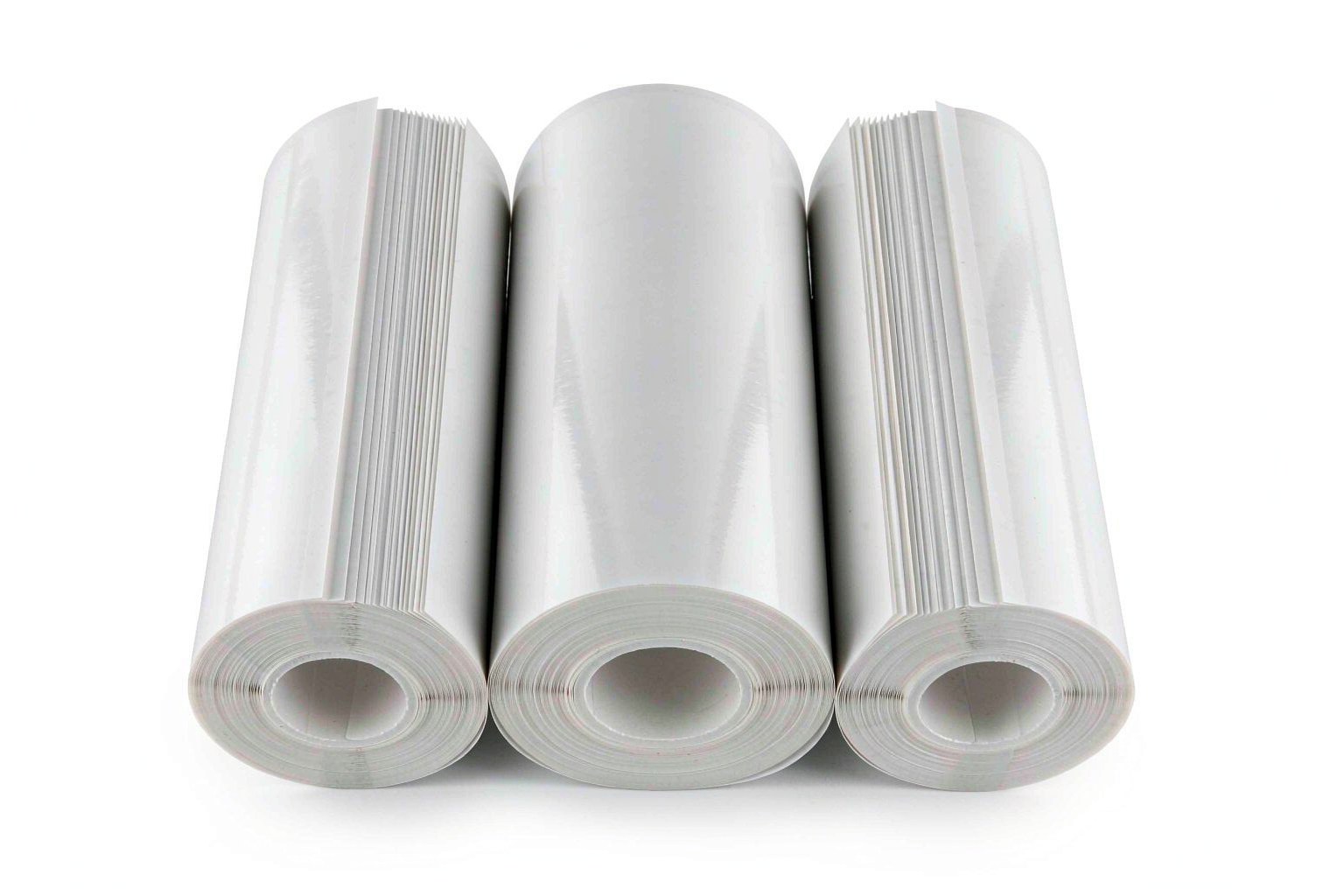
The release coating controls how hard it is to peel the label off the liner. The industry measures this as release force, and it is a narrow window.
Too light, and the label slides on the liner during printing and die-cutting — register drifts, the web wanders. Too tight, and the label will not release cleanly at speed: it tears at the peeler plate, or it flies off and lands on the web. Both symptoms look like a press problem and are actually a material problem.
We cure solvent-free silicone at 0.6–1.2 g/m². The number that matters more than the coat weight is the cure completeness, because under-cured silicone migrates. It contaminates the adhesive on the adjacent lap of the roll, and it can travel through the press. This is why "silicone contamination" is a diagnosis worth taking seriously rather than a supplier excuse.
6. The liner: the layer that decides your running speed
The liner is 100 % waste — it goes in the bin — and it is still the layer that most often caps how fast a converter can run, and how well a label survives shipping.
Three liner options cover most of the market:
| Liner | Typical weight / caliper | Best for | Trade-off |
|---|---|---|---|
| White glassine | 60–80 g/m² | General purpose, sheet-fed, most die-cutting | Absorbs moisture; curls in humid storage |
| Brown / kraft glassine | 80–90 g/m² | Heavier constructions, jumbo rolls | Thicker, more waste per roll |
| PET film liner | 23–36 µm | High-speed applicators, thin labels, tight register | Costs more; less forgiving on small presses |
The most underrated risk here is liner curl. Glassine is hygroscopic. A roll coated and slit in a dry plant, then shipped to a coastal warehouse, will pick up moisture; the liner expands more than the facestock and the roll edges curl. On a high-speed applicator that curl is a jam. If you are storing material in a humid climate, either specify a film liner or accept that you need to condition the rolls before running — and say so when you order, because the liner decision has to be made at coating, not after.
Diagnosing a failure: work down the stack
When a converter sends us a complaint, the first question is never "which supplier?" It is "which layer?" This is the decision order we use.
| Symptom | Most likely layer | What to check |
|---|---|---|
| Ink rubs off or cracks after die-cutting | 2 — topcoat | Is the topcoat formulated for this ink chemistry? Is the dry coat weight in range? |
| Label lifts cleanly, glue stays on the product | 3 — primer | Is there a primer at all? Was the facestock surface treated before coating? |
| Label holds, then pops off after 1–3 days | 4 — adhesive | Substrate surface energy vs. adhesive. Is the container treated? |
| Labels slide or drift in the press | 5 — silicone | Release force too light, or silicone migrating |
| Labels will not release at speed / tear at the peeler | 5 — silicone | Release force too tight |
| Roll edges curl in storage | 6 — liner | Humidity at the storage site; glassine vs. film liner |
| Web breaks; matrix will not strip | 6 — liner / 1 — facestock | Liner caliper consistency; facestock stiffness for this web path |
What to put in a purchase specification
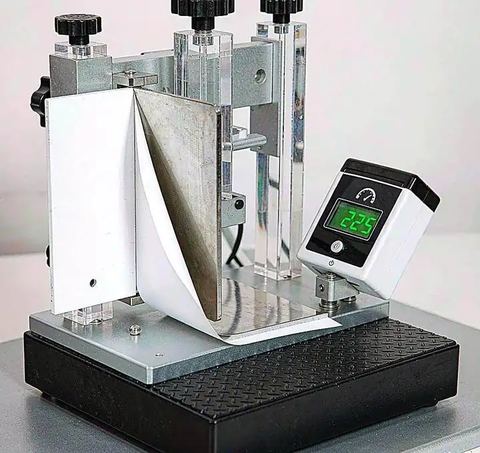
If you take one thing from this guide, make it this. A usable labelstock specification names six things, not one:
- Facestock type, weight or caliper, and finish
- Print platform and ink chemistry (UV inkjet, toner, water-based inkjet, flexo solvent, UV flexo)
- Adhesive family, and whether the substrate is low surface energy
- Minimum application temperature and required service temperature range
- Liner type and caliper
- Roll format: width, unwind direction, core diameter, maximum roll diameter, splice policy
Specifications that stop at item 1 are the ones that generate sample rounds, complaints and rewrites. Specifications that cover all six get quoted once and run once.
How this guide was compiled
The coat weights, caliper ranges and process notes above come from the specifications our own coating and slitting lines work to in Shanghai, and from the failure reports converters have sent us over the years — the pattern of complaints, not a literature review. The surface energy threshold of 36–38 dyn/cm and the per-material dyn/cm values are drawn from published 3M bonding documentation and the critical surface tension tables that converters use for adhesive selection; we have not restated them as our own measurements, and you should treat any published dyne table as a starting hypothesis to be confirmed with dyne test inks on the actual part.
If you are specifying a construction and want the layer-by-layer answer for your specific container and press, send us the substrate, the print platform and the application temperature. We will tell you which of the six layers is the constraint — and if the cheapest answer is a construction we do not coat, we will say that too.
FAQ
Do I need to specify all six layers when I order label material?
No — but you need to specify the six things that determine them: facestock type and weight, print platform and ink chemistry, adhesive family, minimum application temperature, liner type, and roll format. Those six inputs let a competent supplier select the six layers. A purchase order that names only the paper leaves the rest to whoever is quoting.
What is the difference between the topcoat and the primer?
The topcoat sits on top of the facestock and receives the ink, so it decides print quality and ink anchorage. The primer sits underneath the facestock surface and bonds the facestock to the adhesive, so it decides whether the label lifts cleanly and leaves glue behind. They are different chemistries doing different jobs, and a construction can have either one without the other.
Why does the label peel off and leave glue on the product?
That is adhesive transfer, and it is a primer problem rather than an adhesive problem. The adhesive bonded more strongly to the container than to its own facestock because nothing was tying it to the facestock. Ask your supplier directly whether a primer is present and at what dry coat weight — this is a common casualty of cost-down exercises.
How long can I store labelstock before the liner curls?
It depends on the liner and the humidity, not on a fixed shelf life. Glassine is hygroscopic: a roll coated and slit in a dry plant and then stored in a humid warehouse will pick up moisture, the liner expands more than the facestock, and the roll edges curl. If storage humidity is high, specify a PET liner instead. Open the wrapping and let rolls condition in the press room for at least 24 hours before running.
Does a heavier adhesive coat weight always mean better adhesion?
No. Adhesion depends first on whether the adhesive wets out the substrate, which is a surface-energy question, not a coat weight question. Above roughly 36–38 dyn/cm a standard permanent acrylic bonds predictably; below it, more adhesive does not help because the adhesive beads up instead of flowing into contact. Increase coat weight only when the substrate is rough and the adhesive needs to fill texture.