
Our minimum order is 1,000 m². Buyers usually read that as a number and then ask the wrong next question, because a square-metre minimum is not a quantity of rolls and it is certainly not a quantity of labels. Here is what it converts into, and what changes the price before you ever discuss price.
Model guide · last verified 2026-10-21 · published in English · technical questions: contact the lab
The master roll is 1,080 mm wide. One thousand square metres divided by 1.08 m is 926 metres. That is the whole arithmetic: a 1,000 m² order is 926 running metres off the master, delivered in whatever finished widths you specify.
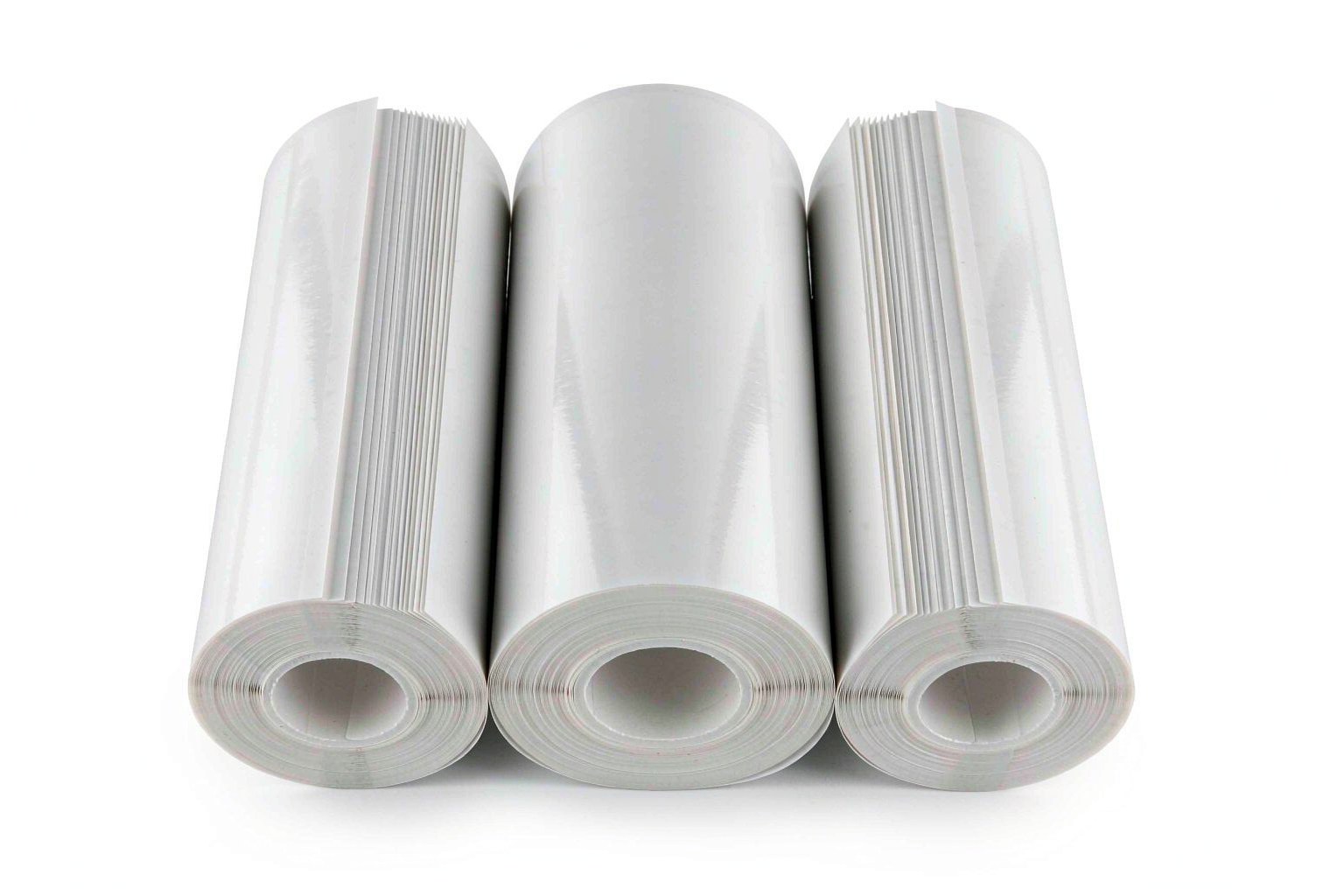
Slitting does not change the area. Split the 1,080 mm into four 270 mm rolls and you get four rolls of 926 m. Split it into two 540 mm rolls and you get two rolls of 926 m. Same adhesive, same facestock, same square metres — different number of rolls, different unwind setup, and a different slitting programme.
This is why "what is your price per square metre" is a real question and "what is your price per roll" is not, unless the width and length are stated. Two suppliers can quote the same per-roll figure for completely different amounts of material.
| Finished width | Rolls from the master | Length per roll | Total area |
|---|---|---|---|
| 1,080 mm (unsplit master) | 1 | 926 m | 1,000 m² |
| 540 mm | 2 | 926 m | 1,000 m² |
| 360 mm | 3 | 926 m | 1,000 m² |
| 270 mm | 4 | 926 m | 1,000 m² |
| 216 mm | 5 | 926 m | 1,000 m² |
| 135 mm | 8 | 926 m | 1,000 m² |
Widths must divide into 1,080 mm without a remainder to use the full master. A 300 mm width gives three usable rolls and 180 mm of edge trim — the trim is still charged, which is why non-divisible widths cost more per usable square metre.
Labels are an area question. A 100 × 150 mm label is 0.015 m², so one square metre yields about 67 labels and 1,000 m² about 66,700. That figure is before waste and it is always optimistic.
Waste comes from three places: the gap between labels on the roll (usually 2–3 mm each way, which on a small label is a large fraction of the area), the lead-in and tail on each roll, and setup waste at the start of a run. On small labels the web gap alone can cost 10–15% of the area, which is why the same 1,000 m² produces very different label counts at 100 × 150 mm and at 20 × 20 mm.
The practical way to size an order is to work backwards from the finished labels you need per year, add the gap and setup waste, and see whether you land above the 1,000 m² minimum. If you land well below it, the honest answer may be to buy through a converter rather than directly — we would rather say that than sell you a roll that sits in your warehouse for two years.
| Label size | Area per label | Labels per m² | Labels in 1,000 m² (no waste) |
|---|---|---|---|
| 100 × 150 mm | 0.0150 m² | 67 | 66,700 |
| 100 × 100 mm | 0.0100 m² | 100 | 100,000 |
| 80 × 50 mm | 0.0040 m² | 250 | 250,000 |
| 50 × 25 mm | 0.0013 m² | 800 | 800,000 |
| 20 × 20 mm | 0.0004 m² | 2,500 | 2,500,000 |
Excludes web gap, lead-in, tail and setup waste. Real yield on small labels is typically 10–20% below these figures.

Before a price exists, five things decide whether an order is straightforward or expensive. None of them is negotiable by arguing about the number afterwards.
Facestock and gauge. PET is dearer than BOPP at equal thickness and about 1.5 times denser, so the same micron uses more material. Thin gauges are not automatically cheaper because thin film runs slower and wastes more at setup.
Adhesive system. Water-based acrylic is the lowest unit cost. Solvent acrylic costs more because the organic carrier has to be driven off and recovered, which uses more energy and more dwell time per metre.
Width and trim. A width that divides into 1,080 mm uses the whole master. A width that does not leaves trim you still pay for.
Liner. Glassine at 60 or 80 gsm is standard. A PET liner is a different product and costs more.
Run length and repeatability. The 1,000 m² minimum exists because of setup: the line has to be brought to condition either way. A repeat order of the same construction is cheaper to run than a new one at the same quantity.
1. Enquiry with five fields. Application, surface, temperature, print process, required width and quantity. Without these the first answer is a guess and the second answer is a correction.
2. Construction recommendation and TDS. We come back with two or three codes from the 115, the reason for each, and the datasheet. Normally within one working day.
3. Free samples. A4 sets of the candidate codes, so the decision is made on your container and your applicator rather than on a datasheet.
4. Quotation and order confirmation. Price is quoted against a specific construction, width, quantity and delivery term — which is why we ask for all five fields first.
5. Coating and slitting. 15–25 days depending on construction and slitting programme. A non-standard width or a construction not currently scheduled sits at the long end.
6. Packing and shipping. Rolls are wound, wrapped and shipped upright on pallets. Shipping documents follow the agreed delivery term.
Specifying width without checking the unwind. A roll that does not fit the arbor, or a core diameter the unwind cannot grip, is scrap. Tell us the core your machine takes.
Buying thin film to save material. At 25–36 µm both BOPP and PET string under a die that would cut 80 µm cleanly. The saving is on the invoice; the cost is in downtime.
Ignoring the web gap. Sizing an order from label area alone under-orders by 10–20% on small labels and the run stops mid-way.
Changing facestock without changing the adhesive. Moving from paper to film to satisfy a customer changes the wetting behaviour and often the adhesive requirement. It is a redesign, not a substitution.
Ordering a year of stock to hit a price break. Adhesive and liner are affected by storage conditions and time. Buy to the consumption rate you can actually prove, and ask about shelf life for the specific construction.
Answered by the coating and conversion team, not by marketing.
An Italian-language take on the same order sheet: face, liner, core, splices and the five lot tests.
Turn your width, thickness and length into area, roll diameter and weight before you size the order.
The vocabulary on a roll label — width, length, OD, core, splice — and how to inspect a delivery.
Why the same micron in a different polymer changes both the price and the weight of the order.
Narrow the 115 constructions down to the two or three worth sampling.
The full range with facestock, adhesive and liner for every code.