
Almost every film enquiry we receive reduces to one question: BOPP or PET. The two look identical on a sample sheet and behave completely differently on a press, on a squeezy bottle and in a recycling stream. Here is the decision, in the order that actually matters.
Model guide · last verified 2026-10-21 · published in English · technical questions: contact the lab
This is the first thing to get straight, because it changes freight, roll handling and the number of rolls a press operator can lift in a shift. BOPP has a density of about 0.91 g/cm³ and PET about 1.40 g/cm³ — a ratio of roughly 1.5 to 1. So a 60 µm BOPP film and a 60 µm PET film are the same thickness and not remotely the same mass.
Put numbers on it. One thousand square metres of 60 µm BOPP weighs about 55 kg of facestock. The same area of 60 µm PET weighs about 84 kg. On a 1,000 m² order — our minimum — choosing PET adds roughly 30 kg of film before you count liner, and it adds it to every roll the operator handles.
This is also why a buyer comparing "60 micron" quotations across suppliers without comparing polymer is comparing nothing. The density difference is physics, and it shows up in yield per tonne: a tonne of 60 µm BOPP gives you about 18,300 m², a tonne of 60 µm PET about 11,900 m².

BOPP is a biaxially oriented polypropylene. It softens in the region of 100–110 °C and loses dimensional stability quickly above that. PET softens far higher — short exposures in the 150 °C range are routine, and that is the reason PET is the film behind most laser-printed and hot-fill label work.
If the label passes through a laser printer or any fuser unit, this single property decides the material. A fuser runs hot enough to distort BOPP; the label comes out wavy, the adhesive creeps at the edges and the sheet jams downstream. That is not a quality problem you can inspect your way out of — it is the wrong polymer.
The same logic applies to containers filled hot, to labels applied close to a heat source, and to anything that will be stored in a vehicle or a glasshouse. Ask what the label sees, not what the room is.
| Property (typical) | BOPP | PET | What it decides |
|---|---|---|---|
| Density | ~0.91 g/cm³ | ~1.40 g/cm³ | Weight and yield per tonne at equal thickness |
| Softening / distortion | ~100–110 °C | well above 150 °C short-term | Laser printing, hot fill, heat exposure |
| Tensile stiffness | lower | higher | Register stability, curl, small-diameter wrapping |
| Conformability | higher — follows curvature | lower — holds its own shape | Squeeze bottles, curved panels |
| Water vapour barrier | better | moderate | Chilled and humid service |
| Die cutting at thin gauges | tends to stretch and string | cuts clean | 25–36 µm work, high-speed dispensing |
| Recycling stream | polypropylene (PP) | polyester (PET) | Monostream recovery of the pack |

Both polymers are available in this range from 25 µm to 100 µm, and the failure modes change across that span more than most buyers expect. At 25–36 µm both films are difficult: they stretch under the die, they web-tension badly, and a worn die that would be fine on 80 µm will produce strings and torn edges. At 75–100 µm the same die cuts cleanly and dispensing becomes reliable, at the cost of stiffness that resists wrapping a small radius.
The practical rule: choose the thinnest gauge that still cuts cleanly on your die and dispenses reliably at your line speed. Going thinner to save material usually costs more in downtime than it saves in film.
There is a second effect with PET at 25–36 µm. Because PET is stiffer at equal gauge, a thin PET behaves on press more like a thicker BOPP — which is why a converter moving from 60 µm BOPP to 36 µm PET often finds the run stable, while a converter moving from 60 µm BOPP to 36 µm BOPP does not.
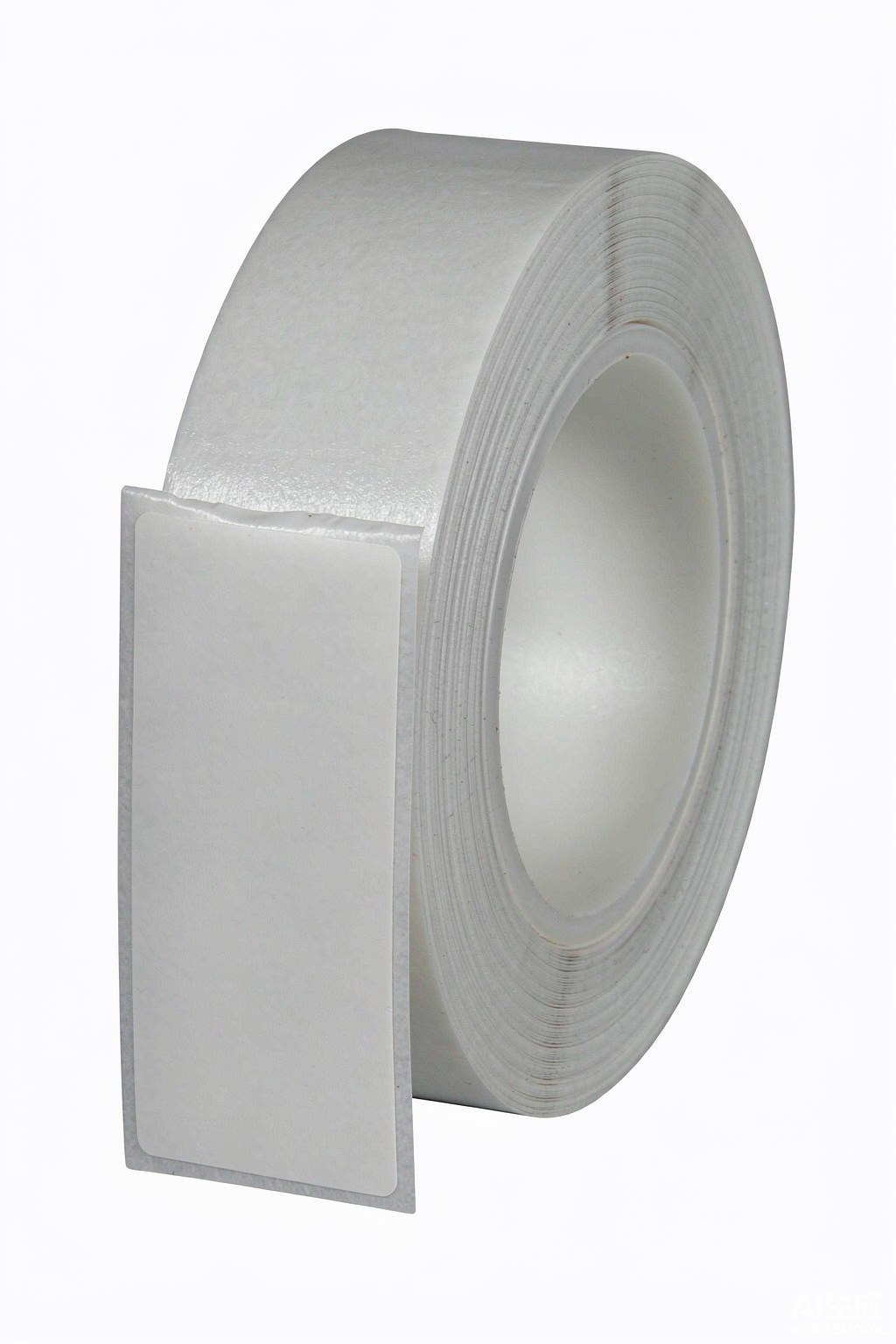
These are the BOPP film constructions we currently coat. Thickness runs 25 to 100 µm and the liner is 60 or 80 gsm glassine, with two exceptions noted in the table. Codes are internal references — quote one and there is no ambiguity about the construction.
| Code | Facestock | Thickness | Liner | Press family |
|---|---|---|---|---|
| FL0201W21 | Glossy white BOPP, removable | 100 µm | 80 gsm glassine | Flexo |
| FL0202W21 | Glossy white BOPP, removable | 100 µm | 80 gsm glassine | Flexo |
| FL0203W21 | Glossy white BOPP, removable | 75 µm | 80 gsm glassine | Flexo |
| FL0204W21 | Glossy white BOPP, freezer | 50 µm | 60 gsm glassine | Flexo |
| FL0205W21 | Glossy white BOPP, removable | 75 µm | 60 gsm glassine | Flexo |
| FL0206W21 | Glossy white BOPP, solvent | 100 µm | 60 gsm glassine | Flexo |
| FL0207W21 | Glossy white BOPP, removable | 25 µm | 60 gsm glassine | Flexo |
| FL0208W21 | Glossy white BOPP, solvent | 75 µm | 60 gsm glassine | Flexo |
| FL0209W21 | Glossy white BOPP, freezer | 100 µm | 60 gsm glassine | Flexo |
| FL0210W21 | Glossy white BOPP, hot-melt | 36 µm | 60 gsm glassine | Flexo |
| FL0211W21 | Glossy white BOPP, removable | 60 µm | 60 gsm glassine | Flexo |
| FL0212W21 | Glossy white BOPP, solvent | 60 µm | 60 gsm glassine | Flexo |
| FL0213W21 | Glossy white BOPP, freezer | 100 µm | 60 gsm glassine | Flexo |
| FL0214W21 | Glossy white BOPP, hot-melt | 80 µm | 60 gsm glassine | Flexo |
| FL0215W21 | Glossy white BOPP | 80 µm | 30 µm clear PET | Flexo |
| MJ0801W21 | Pearl white BOPP, solvent | 36 µm | 80 gsm glassine | Memjet |
| MJ0802W21 | Pearl white BOPP | 60 µm | 80 gsm glassine | Memjet |
| MJ0803W21 | Pearl white BOPP, matte | 25 µm | 80 gsm glassine | Memjet |
| MJ0901W21 | Matte white BOPP | 75 µm | 80 gsm glassine | Memjet |
| MJ0902W21 | Matte white BOPP | 25 µm | 80 gsm glassine | Memjet |
| UV0201W21 | Glossy white BOPP | 36 µm | 60 gsm glassine | UV inkjet |
| UV0207W21 | Glossy white BOPP | 60 µm | 60 gsm glassine | UV inkjet |
| UV0301W21 | Matte white BOPP | 36 µm | 60 gsm glassine | UV inkjet |
| UV0307W21 | Matte white BOPP | 75 µm | 60 gsm glassine | UV inkjet |
| UV0401W21 | Transparent BOPP | 80 µm | 60 gsm glassine | UV inkjet |
| UV0407W21 | Transparent BOPP | 50 µm | 60 gsm glassine | UV inkjet |
| UV0707W21 | Holographic BOPP | 50 µm | 60 gsm glassine | UV inkjet |
| PC2007W31 | Glossy white PP | 60 µm | 135 gsm white | Indigo |
| PC7407W31 | Matte white PP | 75 µm | 135 gsm white | Indigo |
| TPP5007W31 | Transparent PP | 50 µm | 135 gsm white | Indigo |
| LJ0301W21 | Pearl white BOPP | 75 µm | 135 gsm white | Laserjet |
PET covers the same 25–100 µm span with a much wider surface range: clear, glossy white, silver, matte silver, brushed gold, holographic and void. If the job needs a metallised or security look, it is almost always PET — the effect is produced in or on the film, and PET takes it better than BOPP.
Two constructions use a PET liner rather than glassine: FL0308W21 on a 30 µm clear PET liner and FL0215W21 (a BOPP facestock). A film liner is specified where the die-cutting or the dispensing needs a liner that does not compress — laser die cutting is the usual reason, and there is a separate guide on that.
| Code | Facestock | Thickness | Liner | Press family |
|---|---|---|---|---|
| FL0301W21 | Glossy white PET | 60 µm | 135 gsm white | Flexo |
| FL0302W21 | Glossy white PET | 75 µm | 60 gsm glassine | Flexo |
| FL0303W21 | Glossy white PET, removable | 100 µm | 60 gsm glassine | Flexo |
| FL0304W21 | Glossy white PET, solvent | 60 µm | 80 gsm glassine | Flexo |
| FL0305W21 | Glossy white PET, solvent | 80 µm | 60 gsm glassine | Flexo |
| FL0306W21 | Glossy white PET | 80 µm | 80 gsm glassine | Flexo |
| FL0307W21 | Glossy white PET | 80 µm | 60 gsm glassine | Flexo |
| FL0308W21 | Glossy white PET | 60 µm | 30 µm clear PET | Flexo |
| FL0309W21 | Glossy white PET | 75 µm | 80 gsm glassine | Flexo |
| FL0310W21 | Glossy white PET | 36 µm | 60 gsm glassine | Flexo |
| FL0311W21 | Glossy white PET, solvent | 36 µm | 60 gsm glassine | Flexo |
| FL0312W21 | Glossy white PET, solvent | 75 µm | 80 gsm glassine | Flexo |
| FL0313W21 | Glossy white PET, solvent | 60 µm | 80 gsm glassine | Flexo |
| FL0315W21 | Glossy white PET | 50 µm | 60 gsm glassine | Flexo |
| FL0316W21 | Glossy white PET, removable | 36 µm | 60 gsm glassine | Flexo |
| FL0317W21 | Glossy white PET, removable | 75 µm | 60 gsm glassine | Flexo |
| FL0318W21 | Glossy white PET, solvent | 60 µm | 80 gsm glassine | Flexo |
| MJ0401W21 | Glossy white PET | 75 µm | 80 gsm glassine | Memjet |
| MJ0402W21 | Glossy white PET | 80 µm | 80 gsm glassine | Memjet |
| MJ0501W21 | Clear PET | 100 µm | 80 gsm glassine | Memjet |
| MJ0502W21 | Clear PET | 80 µm | 80 gsm glassine | Memjet |
| MJ0503W21 | Clear PET, solvent | 100 µm | 80 gsm glassine | Memjet |
| MJ0504W21 | Clear PET | 25 µm | 80 gsm glassine | Memjet |
| MJ0601W21 | Brushed gold PET | 60 µm | 80 gsm glassine | Memjet |
| MJ0602W21 | Brushed gold PET, solvent | 36 µm | 80 gsm glassine | Memjet |
| MJ0701W21 | Glossy silver PET, solvent | 50 µm | 80 gsm glassine | Memjet |
| MJ0702W21 | Glossy silver PET, solvent | 80 µm | 80 gsm glassine | Memjet |
| MJ0703W21 | Glossy silver PET | 75 µm | 80 gsm glassine | Memjet |
| MJ1001W21 | Holographic PET | 80 µm | 80 gsm glassine | Memjet |
| MJ1002W21 | Holographic PET | 80 µm | 80 gsm glassine | Memjet |
| UV0501W21 | Glossy silver PET | 80 µm | 60 gsm glassine | UV inkjet |
| UV0507W21 | Glossy silver PET | 50 µm | 60 gsm glassine | UV inkjet |
| UV0601W21 | Matte silver PET | 75 µm | 60 gsm glassine | UV inkjet |
| UV0607W21 | Matte silver PET | 50 µm | 60 gsm glassine | UV inkjet |
| OF0108W21 | Matte silver PET, solvent | sheeted | 80 gsm glassine | Offset |
A label on a squeeze bottle is loaded in a way a flat label never is: the container dents, recovers, and repeats that cycle for the life of the pack. The label has to move with it. BOPP, being softer at equal gauge, follows the deformation and comes back. PET is stiffer and tends to hold its original curvature, so the edges lift first and the lift travels inward.
The same property that hurts on a squeeze bottle helps on a small diameter. Where the label has to wrap a tight radius and stay flat, stiffness prevents the facestock from creasing and keeps print register through the wrap. Below roughly 25 mm diameter, thinner film of either polymer wins over thicker.
If you are labelling flexible tubes, pouches or squeeze bottles, specify BOPP and test the actual container — the failure appears after a few hundred squeeze cycles, not on the application line.
A BOPP label is polypropylene; a PET label is polyester. On a PET bottle, a PET label sits in the same stream as the container and a BOPP label does not. On a PP tub the logic reverses. Where a customer is designing for monostream recovery, the facestock is chosen by the bottle, not by the press.
We do not make recycled-content or certification claims for these constructions, and we would be cautious about anyone who does without a documented chain. What we can tell you is the polymer identity of each code, which is the input your own recyclability assessment needs.
There is one practical consequence worth flagging now: if a customer is moving to a PET container to satisfy a packaging target, the label decision usually moves with it, and the adhesive has to be revisited at the same time. A change of facestock alone is not a redesign.
Five fields decide the answer, and a quote that arrives without them is a guess:
1. The container and its geometry. Rigid flat, curved, small diameter, flexible, squeeze. Give the diameter and the material.
2. The service temperature and how the label is applied. Cold application and hot service are different problems.
3. The print process. UV inkjet, Memjet, laser, flexo, offset and Indigo each constrain the surface and the liner, and laser printing rules BOPP out entirely.
4. The look. Clear no-label, white, silver, brushed, holographic, void — the metallised and security options sit mainly on PET.
5. Width, quantity and core. Master width is 1,080 mm, we slit to your finished width, MOQ is 1,000 m², and lead time is 15–25 days depending on construction and slitting programme.
Answered by the coating and conversion team, not by marketing.
Where BOPP wins on a wine bottle and where PET is the better answer, written for Italian converters.
The BOPP family on its own — 25 to 100 µm, gloss, matte, pearl and transparent, with the adhesive options per code.
The surface decision that sits on top of the polymer decision, including what matte does to print and scuff resistance.
54, 60 and 80 gsm liners compared — and when a film liner has to replace glassine.
Why film liners and PET facestocks dominate laser work, and which constructions survive it.
Convert width, thickness and length into area, roll diameter and weight — the fastest way to see the BOPP/PET density difference on your own order.
How a 1,000 m² minimum converts into linear metres by width, core and slit format — and what actually moves the 15 to 25 day lead time.
The full range with facestock, adhesive and liner for every code.