
Three numbers decide what a roll of labelstock actually costs you to run: how many square metres it holds, how big the roll gets as it winds, and what it weighs on the pallet. Change one input and all three move.
Model guide · last verified 2026-10-21 · published in English · technical questions: contact the lab
Defaults are a 1,080 mm wide, 6,000 m long roll on a 76 mm core at 150 µm total thickness — a common master roll shape, not a specification of any particular product. Replace them with your own figures.
Diameter is geometric — it assumes uniform tension and no air entrapment. Real rolls run 1–3% larger. Weight needs total grammage; leave it at 0 if you only want area and diameter.
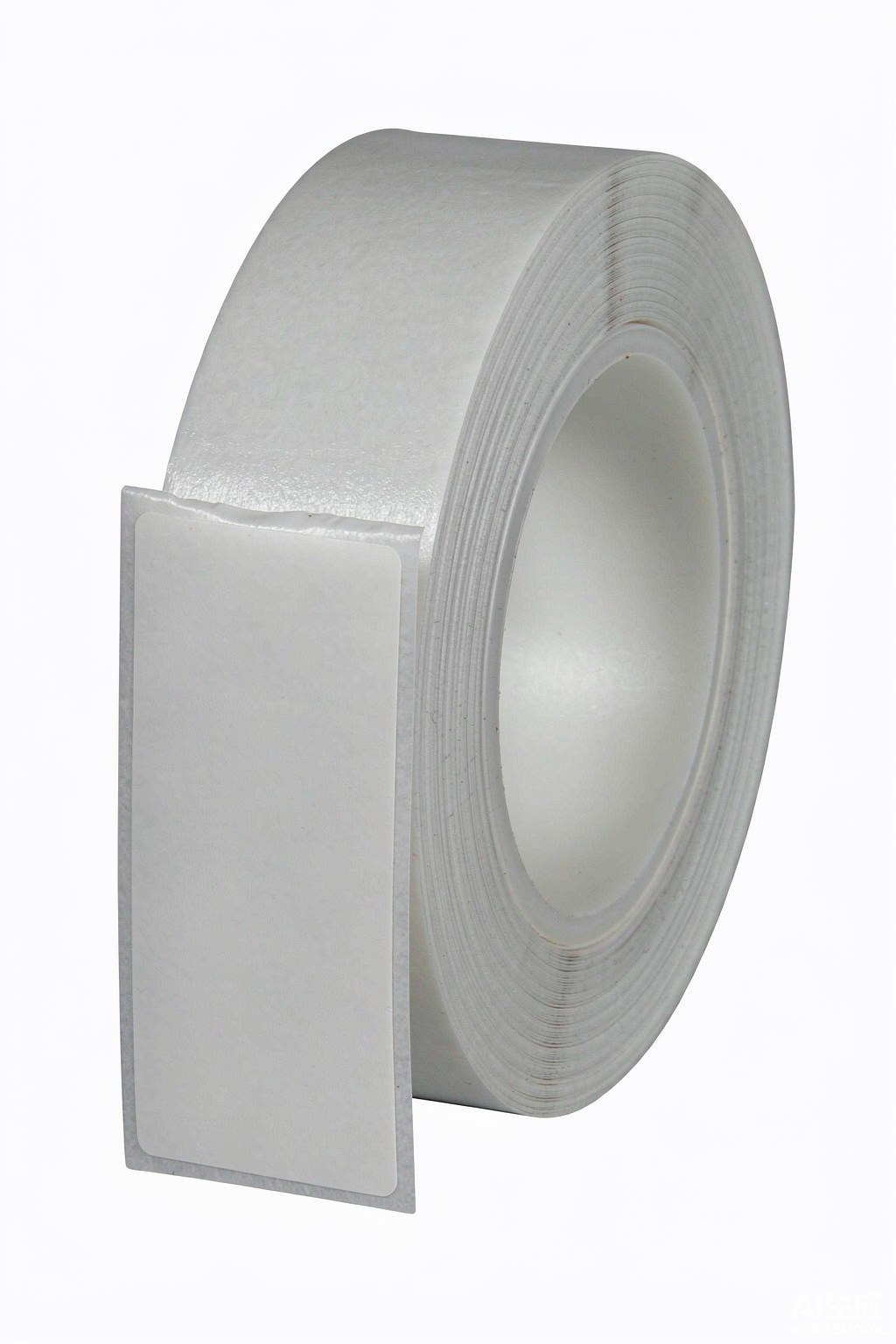
None of this is proprietary. It is geometry and unit conversion, which is exactly why you should check it rather than trust it.
Area. Width in metres multiplied by length in metres. A 1,080 mm roll running 6,000 m gives 1.08 × 6,000 = 6,480 m². This is the number your price per square metre is applied to, so it is the first one to sanity-check against the supplier invoice.
Diameter. A wound roll is a spiral, so the edge of the web forms an annulus when you look at the roll end-on. The area of that annulus equals the web length multiplied by its thickness: π/4 × (D² − Dc²) = L × t. Rearranged, D = √(Dc² + 4·L·t/π). That is the whole formula — no empirical correction factors are being hidden in it.
Weight. Area multiplied by total grammage, divided by 1,000 to get kilograms. Note "total": the grammage of the finished laminate, not the facestock alone. A construction quoted as 80 gsm face is considerably heavier once adhesive and liner are counted, and the difference is what you are paying freight on.
Using facestock thickness instead of total thickness. The diameter formula wants the thickness of the whole laminate — face, adhesive and liner together. Using the face stock figure alone understates diameter by roughly a third on a typical construction (a 60 µm face on a 150 µm laminate gives 680 mm instead of 1,073 mm), and you end up ordering a rewind shaft that does not fit.
Treating calculated diameter as exact. Winding is not perfectly packed. Tension variation, air entrainment and edge alignment all add material, so a real roll typically measures 1–3% larger than the geometric result. Plan the unwind cradle with clearance, not to the millimetre.
A third one shows up less often but hurts more: comparing suppliers on price per kilogram when the constructions differ in grammage. Two rolls of the same physical size can differ by a third in weight, and price per kilogram then tells you nothing about cost per label. Convert to price per 1,000 m² and per 1,000 labels before comparing.
| You are comparing | The number that matters | Why |
|---|---|---|
| Two quotes for the same construction | Price per 1,000 m² | Roll length and width vary; area is the common denominator |
| Constructions of different grammage | Cost per 1,000 applied labels | Weight pricing hides the material you actually consume |
| A new die against an existing one | Area per roll + diameter | Web length changes when the repeat changes |
| Freight to a port | Weight per roll × rolls | Volume rarely binds before weight does on labelstock |
Take the default 1,080 mm × 6,000 m roll and hold everything constant except total thickness. This is the comparison that surprises buyers most, because thickness is usually chosen for print performance and nobody re-checks the logistics.
| Total thickness | Area | Finished diameter | Note |
|---|---|---|---|
| 100 µm | 6,480 m² | ≈ 877 mm | Thin film construction — more metres per roll of the same diameter |
| 150 µm | 6,480 m² | ≈ 1,073 mm | Mid-range laminate |
| 200 µm | 6,480 m² | ≈ 1,238 mm | Heavy construction — check cradle and shaft limits |
| 250 µm | 6,480 m² | ≈ 1,384 mm | Approaching the limit of many standard unwinds |
Three places this saves a round trip. First, before you ask for a quote: convert your monthly consumption into square metres and into rolls, so the quantity you give is the quantity you will order. Second, before you accept a roll size: check that the finished diameter clears your unwind and that the weight is inside your pallet and freight limits. Third, before you change construction: if you move from a 150 µm laminate to a 200 µm one, the run length per roll drops and your changeover count goes up even though the roll looks the same.
If the numbers say you need a diameter your equipment cannot take, the answer is usually a shorter roll rather than a thinner construction — tell us the maximum diameter and we will set the run length to suit. Our master width is 1,080 mm and we slit to order, so width is rarely the binding constraint; length and diameter usually are.
Answered by the coating and conversion team, not by marketing.
Narrow 115 constructions down to the two or three that fit your application before you ask for samples.
Thickness from 25 to 100 µm compared — the input this calculator needs most often.
54, 60 and 80 gsm liners and how liner weight changes the run.
The full range with facestock, adhesive and liner for each code.
Take the numbers this calculator produces — OD, length, core — and write them onto a purchase specification.
What 1,000 m² becomes in slit rolls and finished labels, and what moves the price before you ask for it.